Voices from the Schoolroom: mathematics education in England, 1650–1750
This three-year, AHRC-funded project explores how mathematics was taught in England between 1650 and 1750, and how that teaching evolved in response to the social, political, and economic changes of the period.
The period saw a population-level shift: from widespread indifference to widespread conviction of the essential importance of mathematics. It saw a corresponding shift in individual attitudes to learning mathematics, and to teaching it. And it saw changes in the policies of institutions such as trade guilds, the Navy and the Army towards mathematical education and its utility.
Our project uses newly digitised, newly catalogued and newly discovered manuscript sources, such as schoolbooks, school curricula, letters, and diaries, as well as the riches of early modern print, to explore how these changes played out in the lives of individual students and teachers. It looks at the individual decision to learn mathematics, the individual or institutional decision to teach it, and how and why those decisions were made. It looks at the careers of individual mathematical teachers, and at the trajectories of those they taught: how they embedded their new mathematical skills – and their new-found attitudes to mathematics – into their everyday and professional lives.
Ranging across grammar schools, private academies, charity schools, artisan workshops, and the activities of private tutors and professional instructors, and paying particular attention to the mathematical education of girls and of children from poor backgrounds, the project is producing a rich, detailed picture of how mathematical learning became embedded in early modern English culture, preparing the way for the industrial and economic changes of the later eighteenth century.
How did mathematics acquire its present position of social and cultural importance? How did the European world of ideas move from the sixteenth-century vision of a closed set of ‘mixed sciences’ to the eighteenth century’s sense of mathematics’ almost unbounded usefulness and importance to economic wellbeing? How did specific regions, countries and populations experience that shift, and how did individuals actually acquire new knowledge and new attitudes about mathematics?
These top-level questions about the social and cultural trajectory of mathematics lie behind this project and shape its work. Our project focuses on mathematical teaching and learning in England from 1650 to 1750, a case study which enables us to consider both the genesis of scientific societies and periodicals, and the earliest stages of industrialisation, and to probe in detail how individual and collective experiences of mathematics impacted the path from the one to the other. Who learned mathematics, and where; what mathematics did they learn, and who was left behind? Who acquired a belief in the epistemic importance of mathematics, and who remained sceptical? Who accepted the new narrative about the economic and personal importance of mathematics, and who resisted? Who actually benefited personally by learning mathematics, and how; and who, again, was left behind?
This project examines how the attitudes and agendas of those with political and intellectual power created change in mathematical education; but it also foregrounds the agency and agendas of those who taught and learned, and who by doing so created the modern location of mathematics in culture.
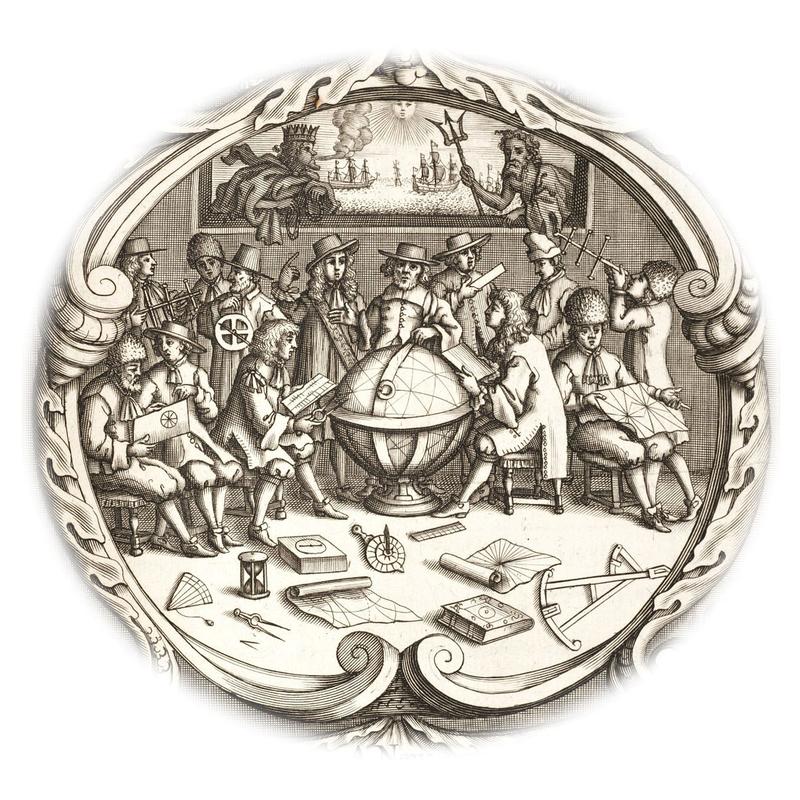
A scene of mathematical learning in 1680.
Mathematical Teachers in the Early Modern World
The Queen’s College, Oxford