Professor Helena Hamerow
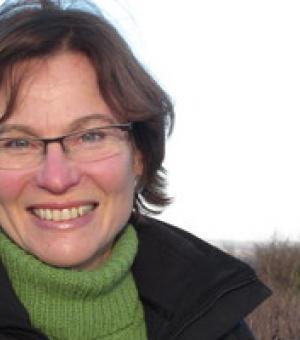
Professor of Early Medieval Archaeology
St Cross College
My research and publications focus on the archaeology of rural communities in early medieval Europe, particularly around the North Sea. I am especially interested in the impact of the establishment of kingdoms, monasteries and towns on rural producers and on the early medieval countryside. My publications in this area include two books, Rural Settlements and Society in Anglo-Saxon England (OUP 2012) and Early Medieval Settlements: The Archaeology of Rural Communities in Northwest Europe AD 400-900 (OUP 2002). I am currently PI of two projects: ‘Feeding Anglo-Saxon England’, which is analysing the preserved remains of medieval crops, weeds and livestock in order to investigate the so-called medieval ‘agricultural revolution’; and ‘Women of the Conversion Period’, which is analysing seventh-century burials to investigate the role of exogamy.
Research Interests
- The archaeology of early medieval Europe
- Rural communities in the early Middle Ages
- Early medieval farming
- The role of women during the Conversion Period
My research and publications focus on the archaeology of rural communities in early medieval Europe, particularly in the North Sea Zone. I am especially interested in the impact of the establishment of kingdoms, monasteries and towns on rural producers and on the early medieval countryside. My publications in this area include two books, Rural Settlements and Society in Anglo-Saxon England (OUP 2012) and Early Medieval Settlements: The Archaeology of Rural Communities in Northwest Europe AD 400-900 (OUP 2002).
I am currently PI of a 5-year, ERC-funded project, ‘Feeding Anglo-Saxon England. The Bioarchaeology of an ‘Agricultural Revolution’, which is analysing the preserved remains of medieval crops, weeds and livestock in order to investigate the so-called medieval ‘agricultural revolution’ (Hamerow et al. 2020; https://feedsax.arch.ox.ac.uk).
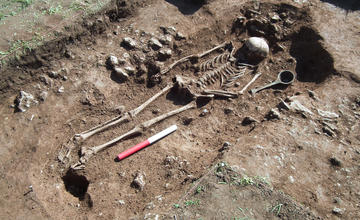
I have also been involved in several fieldwork projects in the Upper Thames Valley investigating the origins of the kingdom of Wessex and how the leading families of the Gewisse (who later came to be known as the West Saxons) used material culture and the landscape itself to consolidate their position (www.arch.ox.ac.uk/wessex). The discovery of several richly furnished female burials in the Upper Thames region (including one near the prehistoric standing stones at Rollright, see image) has also led me to investigate the changing role of women in England more widely during the Conversion period (Hamerow 2015 and 2016). ‘Women of the Conversion Period’ is analysing oxygen and strontium isotopes in seventh-century burials to investigate levels of mobility, especially of exogamy, in a period when women played a particularly prominent role in English history.
I am co-Director of excavations at the Roman small town of Dorchester-on-Thames (www.arch.ox.ac.uk/DOT1) and PI of the AHRC-funded Novum Inventorium Sepulchrale, an on-line database of Anglo-Saxon graves and grave-goods from Kent: http://inventorium.arch.ox.ac.uk.
Dorchester-on-Thames excavation website and blog: www.arch.ox.ac.uk/DOT1 and discoveringdorchester.blogspot.com
Publications
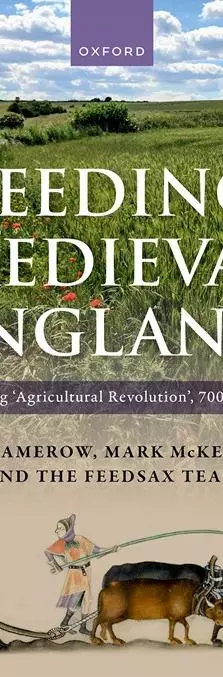
Feeding Medieval England: A Long ‘Agricultural Revolution’, 700–1300
Helena Hamerow, Mark McKerracher, and the Feedsax Team
As in the rest of Europe, the population of medieval England grew steeply, especially between the tenth and thirteenth centuries. This volume investigates how medieval farmers managed to produce sufficiently large harvests to sustain this growth—which in turn fuelled a major expansion of towns and markets—and the impact of this ‘cerealisation’ on the landscape.
DPhil Students
I would like to hear from potential DPhil students regarding early medieval archaeology and material culture.
In the Media
- 2014 - King Alfred and the Anglo-Saxons - BBC 4
- 21 Feb 2011 - ‘Today’ Programme - Interviews on Radio 4 and Radio 5-live
- September 2010 - Digging for Britain - BBC 2
- June 2010 - ‘Time Team’, ‘In the Hall of a Saxon King’ - Time Team S17-E05
- 2009 - Presenter of ‘The Lost World of the Vikings' - Atlantic Productions for The History Channel