

Professor Bryan Ward-Perkins

Tutor in Late Antique and Medieval History
Trinity College
I have published extensively on urban and economic history, written a much discussed book on The Fall of Rome and the End of Civilization. My most recently completed work was a major collaborative project on the 'Last Statues of Antiquity', which has resulted in a freely available database and a print overview volume.
Since January 2014 I have been leading a European-funded project to chart and discuss the origin of the cult of saints within Christianity, investigating this development across all the linguistic and cultural groupings of early Christianity: Syriac, Georgian, Armenian, Coptic, Greek and Latin.
Research Interests
- Origin of the cult of Christian saints.
- The archaeology, architecture and art history of Late Antiquity.
- Urbanism, from Roman into post-Roman times.
My interests are in the period of transition from a Mediterranean and European world dominated by a pagan Roman Empire, to one of established Christianity, western barbarian kingdoms, an embattled Byzantium, and a powerful Muslim caliphate. Until recently, my primary interest has been the material culture of the period, in all its manifestations: from the humble remains of rural settlements, to the honorific statuary of cities and the lavish decoration of rulers’ palaces. With my current ERC project, I am now engaged in examining the new, and ever-growing, power of Christian saints. When and how did Christianity adopt the idea that long-dead martyrs and other holy figures could help us mortals in the present life? And how did the many manifestations of this belief develop (such as the fascination with relics, the celebration of saints’ feast-days, the seeking of cures, pilgrimage to saints shrines, etc.). My interests tend to be in a broad comparative picture, and the Cult of Saints project reaches from the Caucasus and the Persian empire, to Britain and Iberia.
Publications
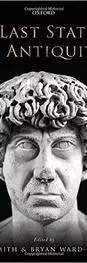
The Last Statues of Antiquity
(with R.R.R. Smith, ed.)
Spanning centuries and the vastness of the Roman Empire, The Last Statues of Antiquity is the first comprehensive survey of Roman honorific statues in the public realm in Late Antiquity. Drawn from a major research project and corresponding online database that collates all the available evidence for the 'statue habit' across the Empire from the late third century AD onwards, the volume examines where, how, and why statues were used, and why these important features of urban life began to decline in number before eventually disappearing around AD 600. Adopting a detailed comparative approach, the collection explores variation between different regions-including North Africa, Asia Minor, and the Near East-as well as individual cities, such as Aphrodisias, Athens, Constantinople, and Rome. A number of thematic chapters also consider the different kinds of honorand, from provincial governors and senators, to women and cultural heroes. Richly illustrated, the volume is the definitive resource for studying the phenomenon of late-antique statues. The collection also incorporates extensive references to the project's database, which is freely accessible online.