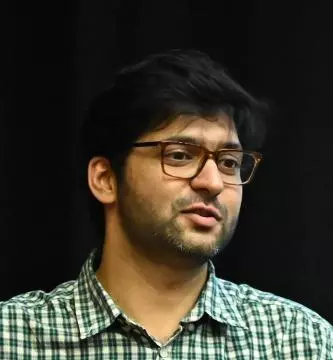
Pranav Sharma
DPhil Student
pranav.sharma@history.ox.ac.uk
Research Topic: Scientific Sovereignty & Post-Colonial Space Futures: Polity and Imagination of First Fifty Years of Indian Space Programme
Supervisors: Faisal Devji and Rob Iliffe
My doctoral research examines the first fifty years of the Indian space programme and argues that it was never only a sequence of technological achievements. Those decades are the period in which independent India forged, contested and articulated its sovereignty and its vision of the future. I treat the programme as a site at which scientific knowledge and national identity were produced together, and I argue that decisions which appear purely technical, from the design of satellite transponders to the choice of launch vehicle systems, were expressions of what it meant for the Indian state to be modern and self-reliant in a post-colonial world.
The thesis therefore rests on two archives that are seldom read together. The first is textual: parliamentary debates, policy papers, public lectures and the coverage of the English-language and vernacular press, which show how ideas about self-reliance and the social contract of science were formed and disputed. The second is technical: mission reports, technology transfer negotiations, and the hardware itself, which encodes commitments that nobody set down in prose. My research draws on holdings at the Indian Space Research Organisation and its centres, Physical Research Laboratory, Tata Institute of Fundamental Research, Raman Research Institute, Indian Institute of Astrophysics, Prime Ministers Museum and Library, and National Archives of India, together with material at the European Space Agency, Roscosmos, and NASA. I read the memoir and institutional literature in tandem with India's political and economic history.
The existing historiography is substantial but it leaves the science as a black box. General accounts remain predominantly technological and do not examine the conditions under which the choices were made, while the political histories that might have supplied those conditions rarely place large technological enterprises at the centre of intellectual life. My project is a sustained intellectual history of the programme.
Three questions organise the work. How did the intellectual climate of early post-colonial India and the distinct visions of Nehru, Bhabha, Sarabhai, Dhawan, and subsequent prime ministers and ISRO chairs shape both the conception of the programme and the policy that governed it? How did the emphasis on societal applications and the insistence on autonomous launch capability come to carry the weight of national argument? And how was scientific sovereignty itself formalised and pursued as India moved from Cold War non-alignment to the liberalisation of the 1990s led by Dr Manmohan Singh?
I trained as an engineer and a physicist, and I have worked in science policy and scientific diplomacy. I have curated the space museum at the B. M. Birla Science Centre, consulted for the Indian National Science Academy, advised the United Nations International Computing Centre, revised the curriculum for the Bhutan Baccalaureate, and co-authored a graduate text on astrophysics.
Alongside my academic work, I write for a general readership on science and its politics. My book with Prof. Takaaki Kajita on the history and physics of the neutrinos is forthcoming from Oxford University Press.