

Dr Philippa Byrne

Associate Professor in History, 1000-1500
philippa.byrne@conted.ox.ac.uk
I am a historian of the intellectual and political culture of the Middle Ages. My work examines the ways in which medieval thought was transformed in the period c.1000-c.1300. Before taking up my current position, I held posts as an Assistant Professor at Trinity College Dublin, a Departmental Lecturer at Oxford, and as a British Academy Postdoctoral Fellow.
Research Interests
My research examines the intellectual and political transformations of the twelfth and thirteenth centuries, across Europe and the Mediterranean, and across Arabic, Greek, and Latin cultures. These transformations are sometimes labelled the ‘Twelfth-Century Renaissance’, and my work weighs the meaning and implications of that label.
I am particularly interested in the ways in which new ideas, texts, and translations shaped new institutions, like universities, and stimulated the creation of new social groups, such as lawyers, administrators, and students. I am also interested in the persistence of older traditions and customs within these new political structures.
My earlier research examined these questions in the context of the British Isles, by looking at the way in which moral theology developed in the schools of northern France shaped the early English common law. My first book considered how medieval English judges used theological texts to guide them when the law itself was silent or ambiguous.
More recently, I have worked on Sicily and Southern Italy. The Norman Kingdom of Sicily—a trilingual, religiously plural society—provides a fascinating and complex case study for understanding the dynamics of intellectual exchange in the twelfth century. I am currently preparing a book which examines the place of the kingdom within our models of twelfth-century intellectual exchange. More broadly, my research examines the connections between Islamic and Christian polities in the Middle Ages, and the way in which historians theorise and conceptualise those connections.
Publications
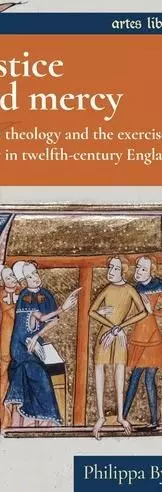
Justice and Mercy: Moral Theology and the Exercise of Law in Twelfth-Century England
This book examines one of the most fundamental issues in twelfth-century English politics: justice. It demonstrates that during the foundational period for the common law, the question of judgement and judicial ethics was a topic of heated debate - a common problem with multiple different answers. How to be a judge, and how to judge well, was a concern shared by humble and high, keeping both kings and parish priests awake at night.
DPhil Students
I would like to hear from students about any topics in medieval intellectual history c.1000 - c.1350, including theological and political thought, historical writing, philosophy, and the reception and transmission of texts. The Medieval Mediterranean between c.1000 and c.1350. Legal history - medieval common, canon, and roman law traditions.