Dr Orçun Can Okan

Teaching Fellow in post-1918 Middle Eastern History
I am a historian of the late Ottoman Empire and the modern Middle East, with a research focus on the ends of empire, regime change, and state succession in the late nineteenth and early twentieth centuries. I received my PhD in History from Columbia University in 2020. I then held a postdoctoral fellowship in Global History and Governance at the Scuola Superiore Meridionale (SSM) in Naples, Italy (2020–23), and worked as a Research Associate on the ERC-funded Moving Stories project at the University of Oxford (2023–25). Before doctoral studies and postdoctoral research, I studied primarily Ottoman history in Istanbul and undertook Arabic language training in Beirut and Cairo. I hold MA degrees in History (Columbia, 2015; Boğaziçi, 2013) and BA degrees in History and Turkish Language and Literature (Boğaziçi, 2010; Boğaziçi, 2010).
Research Interests
A central aim in my research is to examine specific problems of governance as navigated by diverse social actors subject to states' military, administrative, and legal authority. I draw on a rich array of archival sources to trace the stakes and consequences of these problems as experienced by historical actors with differing views, interests, and voices. These concerns have been central to my first monograph, titled Needs That Bind (Stanford University Press, April 2026), which examines the dismantling of the Ottoman Empire and the construction of new political regimes in Turkey, Syria-Lebanon, and Iraq after World War I. The book explores subjecthood, nationality, and citizenship through claims to retirement pensions, alimony cases between former spouses who became nationals of different states, and disputes over land, property, and assets held in pious endowments. The monograph's core concerns are complemented in my research articles, which engage a wider range of themes and sources, including guidebooks, various forms of life writing, press publications produced at key moments of political transition, as well as state correspondence, legal instruments, and petitions.
I am currently developing two main research projects. The first examines pharmacies as hubs of large-scale political transformation from the 1870s to the 1930s, focusing on cities across former Ottoman and Habsburg territories. It asks how changes in governance structures became socially legible and materially consequential in everyday life. The second focuses on particular sites in former Ottoman territories that are widely regarded today as sacred—and, in some cases, also designated as ‘world heritage’. Conceived as a multiyear collaborative research agenda, the project traces the construction, competition, and ‘coexistence’ of sacred sites across different political regimes in lands that gradually became former Ottoman domains.
Dr. Okan is scheduled to teach in MT 2026 the PG Option Paper The Everyday and the (Extra-)Ordinary in (Post-)Ottoman Worlds, 1870s-1930s.
Publications
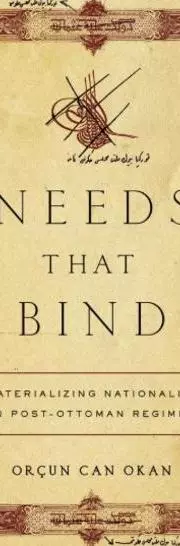
Needs That Bind: Materializing Nationality in Post-Ottoman Regimes
Needs That Bind reconsiders the dismantling of the Ottoman Empire and the construction of new regimes in the decade after World War I, to understand the consequential connections that remained among the new republican regime in Turkey and neighboring French and British Mandates in Syria-Lebanon and Iraq. Orçun Can Okan examines how these new states and their people managed problems of state succession through diplomatic, administrative, and legal interactions with and between bureaucracies.