
Dr Michelle Pfeffer
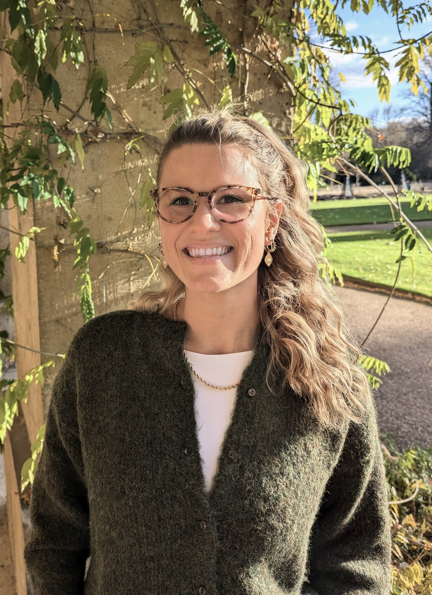
Career Development Fellow in Early Modern History
Oriel College
michelle.pfeffer@history.ox.ac.uk
I'm a historian of science, religion, and intellectual culture in the early modern period. I studied history in Australia before moving to Oxford for an MSc in History of Science, Medicine, and Technology, for which I was awarded the Charles Webster Prize. After finishing my PhD at The University of Queensland, I took up a Prize Fellowship in Early Modern History at Magdalen College, where I was later a Calleva Postdoctoral Researcher. I won the 2026 Singer Prize from The British Society for the History of Science and was recently elected Fellow of the Royal Historical Society. I joined Oriel as a Career Development Fellow in 2026.
Research Interests
As a historian of early modern science and society, I'm interested in how academic scholarship fares in the public sphere. My first book, Inventing Immortality: Heterodoxy and Histories of the Soul in Early Enlightenment England, traces radical thinkers who thought ancient pagans invented the soul. The book argues that the early Enlightenment was shaped as much by the circulation and transformation of knowledge as by new ideas. In the same vein, my latest Historical Journal article follows how ‘sleepy’ eighteenth-century scholarship could become a public sensation. My next project is a new history of public engagement with research that uses archives of early modern public disputations—hugely popular debates, open even to women—to rethink stereotypes about the ivory tower.
Much of my current research centres on the history of astrology, and in particular its changing academic status. In a series of articles I have explored how a discipline once integral to philosophy, astronomy, and medicine was marginalised in early modern universities while flourishing in popular culture. This is the subject of my current project, a trade book entitled RETROGRADE: Power, prediction, and the fate of a science (for more info, contact my agent at Peters Fraser + Dunlop). These interests feed into my collaborative ‘How Sciences End’ project, co-run with Alex Aylward (Oxford) and Joe Martin (Durham).
More broadly, I work on the history of divination and forecasting from the ancient world to the present. With the anthropologist David Zeitlyn, I co-edited Divination, Oracles, & Omens (Bodleian Library Publishing, 2024), which accompanied our Bodleian Library exhibition ‘Oracles, Omens & Answers’ (Dec 2024-Apr 2025). With Zeitlyn, I now lead the TORCH Network, ‘Divination, Oracles, and Omens’. I have written about the role of astrology in the history of epidemiology for Past and Present and in 2023 curated my first exhibition, ‘Plague! at Magdalen: Epidemics and Public Life’. In 2021, I co-organised a conference commemorating the 50th anniversary of Keith Thomas’s Religion and the Decline of Magic (1971) and later wrote an article with Jan Machielsen on the book’s legacy, also for Past and Present. With Simon Dolet, I am organising the conference 'Forecasting the Weather, Between Divination and Science', from 8-9 October in Oxford’s Schwarzman Centre.
I write regularly for History Today and The Conversation and am one of the authors of A History of Astrology, Divination & Prophecy, published by DK of Penguin Random House. I enjoy contributing to radio and podcasts and give a number of public lectures every year.
Publications
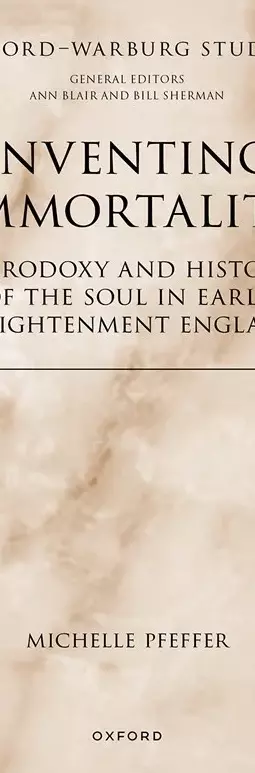
Inventing Immortality
Heterodoxy and Histories of the Soul in Early Enlightenment England
(Oxford University Press, 2026)
Around 1700, England witnessed a heated public debate about the soul’s immortality. Two unlikely figures—a lawyer, Henry Layton, and a physician, William Coward—claimed this belief was a pagan invention not found in early scripture and wrongly adopted by Christianity. Their radical arguments were built from scholarly commonplaces that they rearranged to new ends. Thanks to growing access to books, non-specialists could join theological debates once reserved for experts. Although the work they produced was subversive and amateurish, it still shaped the direction of professional scholarship.
In the Media
- October 2026 - The 18th-Century Search for the Soul - History Today
- February 2026 - For thousands of years, solar eclipses have been associated with the fate of rulers - The Conversation
- May 2025 - The dangerous business of predicting the death of popes – a history - The Conversation
- January 2025 - Hopes, Fears, and Early Modern Astrology - History Today
- December 2024 - Five ways to predict the future from around the world – from spider divination to bibliomancy - with David Zeitlyn, The Conversation
- February 2024 - Bad Omens: When the Astrologers Got it Wrong - History Today
- May 2020 - Before epidemiologists began modelling disease, it was the job of astrologers - The Conversation