

Dr Katrina Navickas

Associate Professor in Eighteenth Century History
Worcester College
katrina.navickas@worc.ox.ac.uk
I am a historian of popular protest, social and political movements and human rights in Britain from 1750 to the present, with a focus on the spaces and places of contention and resistance.
I am best known for my wide range of publications on democratic and labour movements from the Luddites, Peterloo radicals to the Chartists. I attended state school in Rochdale, Greater Manchester, and then read Modern History at St John's College, Oxford, before teaching at Mansfield College and the universities of Edinburgh and Hertfordshire for twenty years. I returned to Oxford in 2026 as Associate Professor in 18th Century History and Tutorial Fellow at Worcester College.
I am committed to demonstrating the value of history in society and politics today through community histories, culture and heritage, and public policy and legislation.
Research Interests
My research interests stretch across the long eighteenth and nineteenth centuries to understand the evolution of popular politics, public order legislation, policing and the dominance of private landownership over the eighteenth and nineteenth centuries. Much of my work draws on Thompsonian traditions of labour history, materialism and culture in understanding class and popular resistance to the state and governing elites, policing and legislation. My research is also cross-disciplinary, applying methods and frameworks from cultural geography and the digital humanities to historical data.
My latest monograph, Contested Commons: A History of Protest and Public Space in England (Reaktion Books, 2025) charts the development of demonstrations and marches in public spaces from enclosure riots, democratic and socialist claims over squares and parks, to far right marches and anti-war sit-ins. My second monograph, Protest and the Politics of Space and Place, 1789-1848 (Manchester University Press, 2016) has been credited to leading the 'spatial turn' in British history.
I am now working on two new strands of research into histories of popular protest and its interactions with the state and landownership. The first strand is on 'pedantic protest', such as resistance through administrative processes, the practical politics of committee organisation and pressure groups, and legal challenges. The second project will focus on the ecologies of property ownership, landscape change, enclosure and popular resistance in Britain from the eighteenth century to the present.
My research promotes how histories of democracy and rights are living stories with contemporary resonances and impact. In 2026, I served as an expert witness at the parliamentary joint committee on 'security, safety and protest: the role of human rights.' I regularly contribute to the media and to popular annual commemorations of significant events in democratic and labour history, including Tolpuddle Radical History School and Newport Chartist Convention. I was a historical advisor for Mike Leigh's 2019 feature film, Peterloo.
My work also intersects with histories of landscape change, the environment, national infrastructure and town and country planning. I am a founding member of the Rural Modernism research network, which was granted substantial UKRI funding for projects on 'Decommissioning the Twentieth Century' and produced an edited collection, New Lives: New Landscapes Revisited (Oxford University Press, 2023). We are now rethinking the meaning and significance of rural history in response to new environmental, ecological and economic imperatives today. I was the Open Spaces Society Fellow at the Museum of English Rural Life in 2020, and I held a British Academy Mid-Career Fellowship in 2018-19.
I am co-editor of the Radical Histories book series for Manchester University Press, and sit on the boards of Social History and Northern History journals. I also promote digital humanities approaches to historical data and visualisation, especially using Geographic Information Systems.
Publications
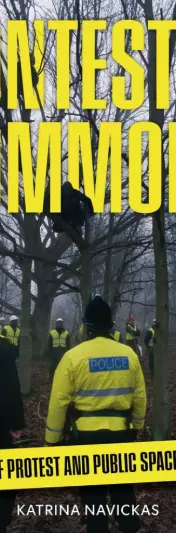
Contested Commons: A History of Protest and Public Space in England
A radical history of England, Contested Commons is a gripping overview of increasingly restrictive policing and legislation against protest in public spaces. It tells the long history of contests over Trafalgar Square, Hyde Park, Cable Street and Kinder Scout, as well as sites in towns and rural areas across the country. Navickas reveals how protesters claimed these spaces as their own commons, resisting their continuing enclosure and exclusion by social and political elites. She investigates famous and less well-known demonstrations and protest marches, from early democracy, trade union movements and the Suffragettes to anti-fascist, Black rights and environmental campaigners in more recent times. Contested Commons offers positive as well as troubling lessons on how we protect the right to protest.
"This is a superb, sweeping but fine-grained history. It's also a highly necessary, politically urgent reminder of what public space is – places for everyone, owned by everyone, accessible to everyone, whether carefully tended or wild – and what it isn't, the tradition of pseudo-public space that runs from Victorian parks to privatised malls".
- Owen Hatherley
DPhil Students
I welcome enquiries from potential postgraduate students interested in the history of protest, political and social movements, landscape and environmental change, and town and country planning in Britain and the world from the eighteenth century to the present.
In the Media
- 28 April 2025 - Great Lives - BBC Radio 4
- 15 April 2026 - joint parliamentary committee on human rights - UK Parliament