
Dr Hannah Skoda

Associate Professor of Medieval History
St John's College
I study history because it sheds critical doubt on the present. It has the potential to help us see beyond assumptions, to dismantle what might seem inevitable, and to treat one another with greater respect. I research the social and cultural history of the later Middle Ages, and am particularly interested in the ways in which people respond to challenges and suffering – oppression, violence, extreme change.
My research interests are wide: I have written on violence, slavery, ideas of sufficiency in the Middle Ages, Dante, medieval students, law, Joan of Arc and medieval saints.
Research Interests
My first book was about violence in medieval France. I was interested in thinking through the normalisation of cruelty and brutality, and the implications both for victims and perpetrators of violence of the belief that this just part of everyday life. I have explored the implications of violence by and against medieval students, much of it raucously humorous.
This led me to an interest in law writ large, and I was honoured to be part of a project involving historians and anthropologists. This addressed the human tendency to try to reduce the messy complexity of life to a series of rules and categories: I co-edited collections on the anthropology and history of legalism, and of ideas about property and ownership. I believe that it is worth repeatedly interrogating the ways in which societies use laws, rules and categories not just to protect, but also to constrain: my most recent edited collection explores the ways in which categories can become repressive in themselves.
Gender can be a profoundly oppressive category. I am intrigued by Joan of Arc and her emotional and spiritual world, and that of the acolytes of a wonderful medieval saint, Wilgefortis. I am now far less interested in exploring the motivations of those who bullied, oppressed and persecuted, than in the richly textured experiences of those who had to face up these behaviours. I continue to be amazed and inspired by those who refuse to be pigeon-holed. Life is too capacious to be filed away neatly.
Recently, I have been exploring the stories of late medieval slaves in the Christian Mediterranean. I am particularly interested in the ways in which many slaves used the gaps between different forms of law to seek marginal improvements in their situations: their legal savvy and courage is often very striking.
My current book project addresses the idea of nostalgia in the Middle Ages. The fourteenth century is often labelled as a century of catastrophe. A fairer assessment describes profound socio-economic, cultural and political changes which had the potential to transform ways of thinking. Many contemporaries responded in profoundly nostalgic terms, harking back to ‘the good old days’, whether the time of their grandparents, or a more nebulous lost golden age. My work examines nostalgia across the social spectrum. Recent anthropologists and philosophers highlight the counter-intuitively hopeful aspect of such an attitude. In many ways, a cross-cultural concept, it was articulated in powerful, lyrical and often subversive ways in the fourteenth century. Fourteenth-century people had to face up to challenges which are frighteningly resonant with those of our own times: the complexity of nostalgic responses to change echo across the centuries.
Publications
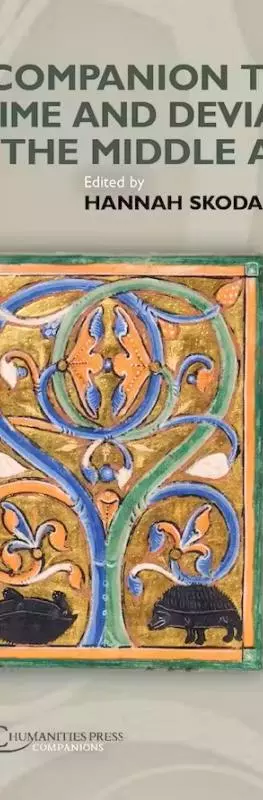
A Companion to Crime and Deviance in the Middle Ages
This reference work examines the ways in which some medieval behaviours and identities were categorized as criminal or deviant. It also explores the implications of modern demonization of the Middle Ages. As well as discussing constructions of deviance, this book also explores the behaviours and identities which provoked these labels and processes. The model is one of reciprocity between behaviours and processes of demonisation and criminalisation.
DPhil Students
I am keen to supervise graduate students researching the social and cultural history of later medieval Europe, with the history of education and of conflict, history of nostalgia, histories of gender, and history of slavery forming areas of special interest.
In the Media
- 5 May 2024 - The Murder Capital of Medieval England - BBC Radio 3 Sunday Feature
- Monthly - History Behind the Headlines - BBC Podcast series with Hannah Skoda and Rana Mitter
- 26 May 2022 - How slavery thrived in Renaissance Europe - History Extra
- 27 May 2020 - How bloody was medieval life? - History Extra
- 13 January 2020 - Medieval myths - History Extra
- 28 December 2016 - The medieval longing for the good old days - History Extra
- 9 July 2015 - Medieval Dread: Student deviance and devilry - Times Higher Education
- 21 May 2015 - History Explorer: Medieval Universities - History Extra
- 29 July 2014 - Making History - BBC Radio 4
- Date - History Extra Podcast (no. 75) - Where