
Dr George Southcombe

Director of the Sarah Lawrence Programme, and Fellow by Special Election in History
Wadham College
My research has focused on two broad, overlapping areas: the history of seventeenth-century dissent, and the relationship between literature and history. In this work I have been engaged in uncovering the social depth of politics, and the importance of nonconformist print culture. In 2012 I published a three-volume edited collection of nonconformist verse. I have also produced, alongside Dr Grant Tapsell, a broader study of the late seventeenth century, which uses visual and literary materials alongside the more conventional sources of political history. In 2019 I published my monograph, The Culture of Dissent in Restoration England: ‘The Wonders of the Lord’. This was the culmination of my work on religious dissent and I am now moving on to other fields.
I wrote a piece on scepticism towards witchcraft for a collection of essays published in honour of my old supervisor, Dr Clive Holmes, in 2017. Since then I have completed a piece with my friend and colleague Dr Alexandra Gajda on the English Witchcraft Act of 1563, which will be published in English Historical Review. I am now in the process of writing a new history of English witchcraft.
I have co-supervised doctoral students working on Quaker theology, Anglo-Japanese relations and seventeenth-century reading practices and politics. My current doctoral students are working on dissenting uses of history, and early modern disordered eating.
Research Interests
My research interests lie within the following headings:
- cultural history
- environmental history
- gender history
- intellectual history
- political history
- religious history
Publications
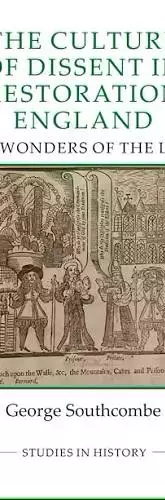
The Culture of Dissent in Restoration England: "The Wonders of the Lord"
This book offers a fresh and challenging new approach to those that the confessional state of Restoration England had no prospect of silencing. It provides case studies of a range of very different but highly articulate dissenters, focusing on their modes of political activism, and on the varieties of dissenting response to the Restoration. Each case study demonstrates the vitality and integrity of witnesses to a spectrum of post-revolutionary Protestantism.
DPhil Students
I would be happy to hear from potential graduate students interested in working on early modern cultural, political and religious history.