

Dr Ellen Paterson

Career Development Fellow in Early Modern History
Keble College
Research Interests
My current research focuses on the impacts of new economic institutions and agents of the state on non-elite subjects, exploring the ways participation in these processes and encounters with economic agents contributed to broader processes of politicisation. I am conducting new research exploring the importance of charters and corporations in the expansion of the early Stuart state across the Atlantic. I am especially interested in the ways through which disputes over trade and resources shaped political culture in these colonies, and in particular, the materiality of petitions which were penned in response and which crossed global boundaries.
I am also conducting research into the economic debates surrounding James's proposed Union with Scotland (1603-1605). Utilising the archival records of the Scottish burghs, I am exploring mechanisms through which Scottish merchants utilised the Union issue as a lobbying moment, and the consultative processes through which merchants were brought into Parliament and crown commissions.
My research interests also include parliamentary lobbying and popular perceptions of Parliament and the ways these developed across the early Stuart period.
Publications
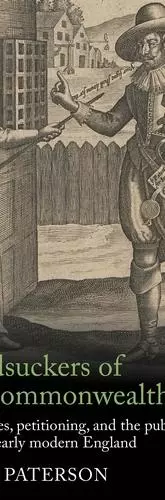
Bloodsuckers of the Commonwealth: Monopolies, petitioning, and the public sphere
(MUP, 2025)
This book offers the first in-depth analysis of anti-monopoly petitioning in late-Elizabethan and Jacobean England. Drawing on a range of manuscript petitions, it reveals the centrality of the issues of monopoly and corporatism for the politicisation of a range of subjects between 1590-1625. Both Elizabeth I and James I liberally granted monopolies and charters as a fiscal device. Petitioning emerged as the main way through which subjects protested these intrusions on their trades and livelihoods. Whilst this activity occurred throughout the realm, it was especially pronounced in the city of London. Members of London's livery companies, bodies which held exclusive rights to trade, petitioned for and against monopolies and charters. Bloodsuckers of the Commonwealth offers a fresh perspective on political culture in this well-studied period by arguing that economic policies generated conflicts, contests, and participation in a nascent public sphere.