Masters Dissertation Prizes 2021-22
Each year the Faculty of History awards prizes to those graduate students who have achieved the best performance overall within their cohort as well as those that have produced the best disseration within their cohorts.
Below are those who were awarded these prizes for the academic year 2021-22. A number of the students have written small summaries of their dissertations, which can be found at the bottom of the page.
Congratulations to all those awarded!
MSt/MPhil History
Euan Huey - Making Morisco Spaces in the Imperial City: Toledo, 1570 – c. 1610.
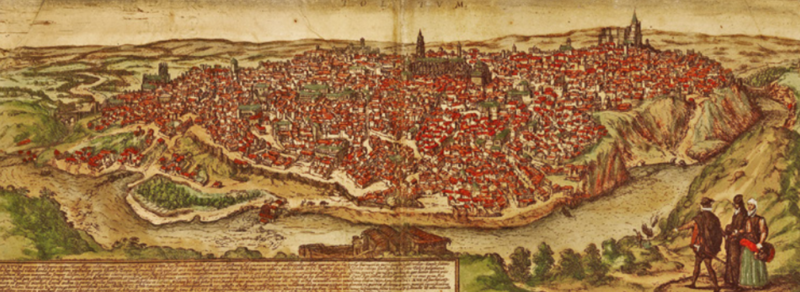
In 1570, the Spanish Crown began to forcibly relocate from Granada thousands of converts from Islam to Christianity, known as Moriscos, across the Kingdom of Castile. Mostly converted through force and coercion, Granadan Moriscos were widely suspected of secretly maintaining their Islamic faith and were outwardly attached to its cultural markers, such as the Arabic language. Their forced resettlement attempted to eradicate their attachment to customs and beliefs associated with Islam by assimilating this minority into Christian society.
This was part of a broader religious undertaking by the Spanish Crown in the long sixteenth-century, which also involved the expulsion of the Jews in 1492, frequent military contestation with the Ottomans in the Mediterranean and the spread of Christianity in Africa, Asia and the Americas by Spanish and Portuguese missions.
Toledo, the spiritual and ecclesiastical centre of the Iberian Peninsula, became home to almost 4,000 Moriscos by the time of their ultimate expulsion from the Peninsula in 1610. Faced with surveillance, inquisitorial persecutions, and restrictions to mobility, residency and employment, Moriscos made this hostile and unfamiliar city their home in the forty-year period between resettlement and expulsion. How Moriscos navigated this was the focus of my masters dissertation.
Through a spatial analysis that considered how Moriscos responded to, interacted with and perceived of different, yet intersecting, layers of space – the home, the neighbourhood and the city – my dissertation demonstrated the ways that Moriscos used their agency to manipulate these spaces and alter their intended uses and meanings. This analysis enabled an appreciation of how Moriscos engaged with a precarious and uncertain situation in creative and lively ways in order to survive, ascend and, at times, resist the efforts of the Crown to assimilate them.
Based on a critical reading of the records of the Inquisition, this project attempted to subvert inquisitorial filters and recover the voices and perspectives of Moriscos from the archive. Further, focusing on Toledo sought to contribute to a ground-up historiography that focuses on local and regional studies in order to avoid essentialising Moriscos as geographically uniform. Dr Stephanie Cavanaugh’s, Morisco Conversions: Belonging, Status, and Legal Action in Early Modern Valladolid (forthcoming), was a tremendous inspiration and it was a privilege to have her co-supervise this dissertation.
While I am no longer working on the Morisco presence in Toledo for my doctoral research, I am continuing to explore questions related to the relationship between Islam and the Iberian world in the context of imperial expansion into Southeast Asia in the sixteenth and seventeenth centuries.
MSt/MPhil Late Antique and Byzantine Studies
Frederick Bird - A Critical Edition of Georgius Pisides, Epigrammata with Introduction and Commentary
My MPhil thesis focuses on the one hundred and twenty surviving epigrams of the seventh-century Byzantine poet Georgius Pisides. Pisides, who lived under the rule of Emperor Heraclius I (610–641), remained one of the best-known poets throughout the Byzantine period. Pisides’ epigrams are short poems which were to be read as inscriptions beneath icons of saints, on the doors of churches or in other physical locations.
None of Pisides’ epigrams survives in situ: all of the stones, wood and paintings which bore his work have long since been lost or destroyed. Nor do we have the original book in which he first wrote the epigrams. Such has been the fate of the vast majority of Byzantine literature. Fortunately, however, the texts have been preserved into modernity thanks to the diligence of many mediaeval scribes in making manuscript copies (and copies of copies, et cetera) of this body of poetry.
Despite their care in copying out a text, scribes were not perfect. Consequently there are many errors in the copies that they made. It is the task of the modern scholar to identify and eliminate errors from the text, in an attempt to restore it to the form in which the author left it.
I have been able to eliminate some errors from the texts of the epigrams by comparing the existing manuscripts and searching for readings which are error-free. The increasing number of manuscripts with digital reproductions available online has meant that I have so far been able to consult all but one of the twenty-six known extant manuscripts of the epigrams. I have found that collating the manuscripts is often a fairly systematic and ‘scientific’ process which is most rewarding when one finds a reading which shines out from the others as being most clearly correct.
Sometimes, however, when all the existing manuscripts offer readings which are manifestly incorrect, I have had to resort to a more ‘artistic’—and usually more speculative—method; having reached a dead-end when all the manuscripts are corrupt, I have needed to make an educated guess based on the available evidence as to what I think Pisides is most likely to have written.
I present the results of my manuscript analysis by printing a revised text of the epigrams with apparatus criticus, for the first time with a full English translation.
The text is preceded by an introduction in several parts, and followed by a line-by-line commentary. In these two sections of my thesis, I explain that the focus of the epigrams is primarily religious, but that within the broad scope of Byzantine Christianity they treat many different subjects, including the life of Christ, Christian festivals, biblical figures, passages from the Bible, churches and Late Antique saints. I have sought to draw attention to some of the defining characteristics of Pisides’ poetic craft, such as his use of semantic ambiguity and oxymoron, as well as his clever puns on subjects’ names. In these sections I also discuss the historical background, his literary sources and matters of poetic metre.
I hope to publish an expanded version of my thesis in the near future, following a series of shorter articles which I have written as off-shoots of my studies on Pisides at Oxford and which are being published in Austrian and Italian journals this year.

Best performance in cohort:
- MSt/MPhil History
- Ananya Malhotra
- Euan Huey - Making Morisco Spaces in the Imperial City: Toledo, 1570 – c. 1610.
- MSt/MPhil Late Antique and Byzantine Studies
- Frederick Bird - A Critical Edition of Georgius Pisides, Epigrammata with Introduction and Commentary
Best dissertation in cohort:
- MSt/MPhil History
- Clare Whitton (Medieval History) - 'San Gennaro and his Miraculous blood'
- Elliot Jordan (Early Modern History) - 'Spanish Blades': English Military Theory, the Spanish Threat and the Military Revolution, c.1558-1604'
- Harrison Goohs (British and European History 1700-1850) - 'German Freedom in a Revolutionary Epoch: The Congress of Rastatt (1797-1799) and End of an Empire'
- Alice Reffin (Modern British History) - 'Drawing the Empire or the Nation? Imagining the Irish Free State in the Posters of the Empire Marketing Board'
- Amanda DeMarco (Modern European History) - 'Constructing Socialist Internationalism: Shanghai Returnees and the GDR’s Vision of China, 1945–1957'
- Grady Owens (History of War) - 'Collegiate Martiality: The American Collegiate Experience and its Influences on Students and Administrators during the First World War'
- Thomas Noriega (Intellectual History) - 'Abounds with Scotticisms': Plato Studies in Enlightenment Scotland'
- Rosa Pouakouyou (Women's, Gender, and Queer History) - 'Carving out space in the women’s movement: Northern Ireland and Spare Rib Magazine, 1980-85'
- Pádraig Nolan (Women's, Gender, and Queer History) - 'Contingent Destination: Michael Dillon, Harold Gillies, and the Pre-Transsexual History of Medical Transition in Britain 1946-1955'
- Sara Green (MSt Global and Imperial History) - “Tear off the veil that still hides mores, customs and ideas”: Sexuality, racialised femininities and problematising Islam in the French Algerian Ethnographic Imaginaire, 1881-1931
- Krystof Jirku (MSc Economic and Social History) - "Forecasting Neo-Liberal Reform": Prognosticism, Technocracy, and Economic Theory in Normalisation- and Transformation-Era Czechoslovakia
- Jingyang Rui (MPhil Economic and Social History) - 'Feast or Famine: The Economic Polarizing Effect of China’s Non-Native Office Appointment System'
- Antony Hollingworth (MSc History of Science, Medicine, and Technology) - 'The introduction of a diphtheria immunisation programme during a time of war'
- Margaret Clipson (MSt History of Art and Visual Culture) - 'Framing Devotion: Architectural Symbolism in Royal English Gothic Manuscripts'