Ireland, empire, and the early modern world
Speaker: Jane Ohlmeyer (Trinity College Dublin)
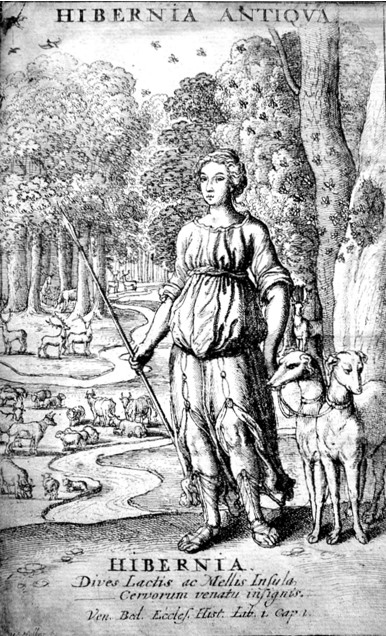
The illustration depicts Hibernia as both shepherdess and huntress, with bees – the symbols of industry and colonization – circling her head and Irish wolfhounds at her side. This, and the accompanying contrasts between the wild forests and the cultivated arable and pastoral lands represents many of the themes that are explored in these lectures which re-examine Ireland’s role in empire through the lens of early modernity. The focus will be on Ireland and the First English Empire (c.1550-1770s) but it is critical, where possible and appropriate, to look to other European and global empires for meaningful comparisons and contrasts. These lectures draw on a wide range of written, visual, and archaeological sources while works of poetry, prose, and performance help to recapture emotions and more nuanced senses of identity.
Four interconnected themes underpin the series. First, as England’s first colony, Ireland formed an integral part of the English imperial system. Second, as well as being colonised the Irish operated as active colonists in the English and other European empires. Third, the extent to which Ireland served as laboratory for empire in India and the Atlantic world is analysed. Finally, the impact empire had on the material and mental worlds of people living in early modern Ireland is examined alongside how these years are remembered today.
Lecture One: Making History (22 January 2021)
The play Making History by Brian Friel, which was first performed in 1988, is set on the eve of the Nine Years War (1594-1603), of the completion of the English conquest of Ireland, and of the onset of a period of intense anglicisation, colonisation and commercialisation. The play is used to explore these themes, which reoccur across the lecture series, along with three chronological contexts pertinent to any discussion of empire and Ireland. First, the turn of the seventeenth century, the transitionary moment in which the play was set; second, the late 1980s, when at the height of the Troubles the play was performed first in Derry and then across Ireland; and, finally, the context of today, the early 2020s, as we continue to wrestle with the legacy of empire in Ireland, in the UK, and around the world.
Lecture Two: Anglicisation (29 January 2021)
How Ireland was made English is the subject of the second lecture and will interrogate, under the umbrella of anglicisation, conquest, colonisation, ‘civilisation’, cultivation, and commercialisation. When viewed from the perspective of early modernity what is clear is that anglicising processes did not occur in a linear way, nor was the outcome predestined. On the contrary, what becomes apparent is the haphazard, messy and clumsy nature of the processes surrounding anglicisation and the very real limitations on central power.
Lecture Three: Assimilation (5 February 2021)
This lecture examines colonial Ireland as an integral part of the English imperial system. While there is no escaping discussion of race, religion, and rebellion or of extreme violence, exploitation, and expropriation, there are also stories of assimilation, acceptance, negotiation, survival, and tolerance that need to be told. The traditional configurations of kingdom, colony, and empire are viewed through the prism of gender and the particular relationship between marriage and cultural assimilation is also examined.
Lecture Four: Agents of Empire (12 February 2021)
This lecture looks at the Irish, Catholic and Protestant, as agents of empire who played active roles in European global expansionism. By 1660 Irish people, mostly men, were to be found in the French Caribbean, the Portuguese and later Dutch Amazon, Spanish Mexico, and the English colonies in the Atlantic and Asia where they joined colonial settlements, served as soldiers and clergymen, forged commercial networks as they traded calicos, spices, tobacco, sugar, and slaves. How did these encounters and experiences shape their identity and how did others perceive and represent them? Equally, how might this hibernocentric perspective challenge, complicate and even change received understandings of empire, especially the English one?
Lecture Five: Laboratory (19 February 2021)
This lecture explores the extent to which Ireland served as laboratory both for imperial rule and for resistance to that rule. Processes and practices of government, especially legal and landed ones and others relating to anglicisation, characterised from the mid-sixteenth century the implementation of English imperial authority in both Ireland and across the English empire. In addition to analysing influences and actions distinctive to English rule in Ireland, India and the Atlantic, it is important to acknowledge those shared more generally by early modern empires. Equally challenging is how we draw insights across time and make meaningful connections from the early modern into the modern period, rather than taking a teleological approach and reading history back from the present.
Lecture Six: Empires (26 February 2021)
The final lecture focuses on the impact of empire on Ireland and how empire has been remembered. How did empire shape the lives of those living in Ireland, and how is Ireland’s engagement with and experience of empire in the early modern period remembered (or not) and represented/mis-represented? Today in Ireland some celebrate and some excoriate connections with the British Empire. Others have either conveniently forgotten or are simply ignorant of Ireland’s imperial past. However the decade of commemorations (2012-2022) in Ireland and campaigns around ‘Black Lives Matters’, Brexit, and ‘Rhodes must fall’ have kindled a greater awareness of the importance of revisiting the history of empire, if only to better understand its legacy and how it has shaped the present.