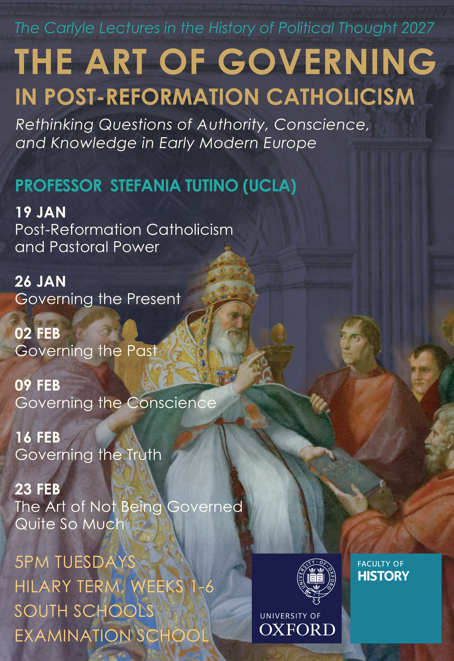
The Carlyle Lectures 2027
Governing the Present
26 January 17:00 | South School, Examination Schools
Professor Stefania Tutino (University College London)
The Pope claimed authority over consciences; princes claimed authority over territories. After the Reformation, those claims increasingly collided. This lecture examines what happened when spiritual obedience acquired political consequences, and when Catholic theologians tried to define how far papal authority could reach.
The Art of Governing in Post-Reformation Catholicism: Rethinking Questions of Authority, Conscience, and Knowledge in Early Modern Europe
How did the Catholic Church govern after the Reformation? This lecture series examines that question through a series of studies on authority, conscience, memory, and truth in early modern Europe. Moving between theology and administration, political theory and archival sources, Rome and the localities, it traces the institutions and practices through which the Church sought to guide conduct and regulate its flock. What emerges is a world of overlapping jurisdictions and competing authorities, where governing depended as much on negotiation and adaptation as on command.