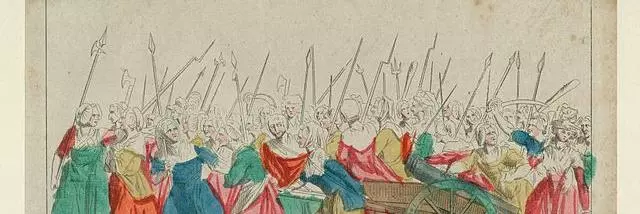
Recent generations of historians have risen to the challenge of finding ways of characterising this period that transcend older notions of a passage from ‘traditional’ to ‘modern’. How best to characterise Enlightenment, and what it meant to whom, continues to attract controversy, as do the causes, nature and effects of revolutions, political and other. There has been lively interest in developments in state forms and in the ‘public sphere’, in attempts to promote new systems of ‘manners’ (whether industrious, polite or democratic) and increasingly in interactions between Europe and the wider world.
Oxford has a strong tradition of work including interdisciplinary work on British history in the long eighteenth century, on the enlightenment and on the French revolution and its effects. The outstanding print resources of the Bodleian Library are complemented by a wealth of digital resources, accessible to students on-course wherever in the world they may be working. Alongside faculty research seminars focussing on this period (see e.g. ‘Oxford Seminar in Mainly British History 1680-1850’ community page on Facebook), there are seminars and workshops at the Voltaire Foundation (www.voltaire.ox.ac.uk), which is dedicated to ‘disseminating research in the enlightenment’. TORCH hosts an interdisciplinary network for ‘Romanticism and eighteenth-century studies’, RECSO.
Option courses particularly relevant to Britain and Europe 1700-1850 typically include:
Faculty and Research Culture
The faculty and university have particular strengths in the history of political culture in Britain, Ireland and the Atlantic world; the Napoleonic empire; the history of women and of childhood; in the history of war (including political, social and medical dimensions of warfare), in intellectual history, and in urban and rural social history.
For more information on our academics and their subjects, please search within our people section.
Faculty seminars bring together staff, doctoral and master’s students working in the field, to hear speakers including doctoral students, external and internal to the university. Seminars relating to this period include: early modern European; mainly British history 1680-1850; modern British history and long nineteenth-century Europe. Relevant sessions also occur in seminars on Irish history and the history of political thought, economic and social history, global history, the history of the book, science, war etc.