Food and Nutrition in Wartime in the Modern World
12 May 2026
On 16 and 17 April, an international conference on ‘Food and Nutrition in Wartime in the Modern World’ was hosted at St Edmund Hall, organized by Dr Chloe Pieters (St Edmund Hall) (https://www.seh.ox.ac.uk/people/chloe-pieters), Christopher Batten (UCL) (https://www.ucl.ac.uk/social-historical-sciences/christopher-batten) and Rebekah Hodge (UCL) (https://www.ucl.ac.uk/social-historical-sciences/history/people/postgra…).
The topic of hunger in wartime, its impact on civilian morale, and people’s survival strategies has been of significant interest in recent years. Coverage of civilian hunger in Gaza and Sudan by the media has brought knowledge about contemporary suffering into homes around the world. The relevance of the subject has further been sharpened since the conference was initially planned because of the closure of the Straits of Hormuz and blockade of Iran, forcing people to engage with the complexities of war’s impact on supply chains and the impact of such disruptions on food prices, and the extent to which civilian suffering can be weaponized in war. The topics has also attracted considerable academic interest. The European Research Council has funded two major projects on food in wartime, The Global War on Civilians: 1905–1945 at Sciences Po (https://www.sciencespo.fr/histoire/en/research/research-projects/war-on… ) and The Hidden Weapon. Blockade in the Era of the Two World Wars (https://cordis.europa.eu/project/id/101166983). Meanwhile, the French Agence Nationale de la Recherche has funded Food Consumption on the Home Front 1913-1923 – PSOMI (https://anr.fr/Project-ANR-24-CE27-2294). The Food and Nutrition in Wartime in the Modern World conference was fortunate to have speakers from all three of these projects presenting amongst the speakers.
In short, questions of hunger, feeding and morale in times of conflict are uncomfortably alive at present, and this conference sought to contribute to these conversations while enriching our historical understanding thereof; but we also sought to enhance understanding of how war can influence scientific developments in nutrition science and food preservation, and can even influence the spread of scientific ideas to the general population as societies are forced to cook and eat on the basis of nutritional need as much as custom and taste.
Speakers on first panel, on Hunger and Starvation, explored how civilian starvation has been deliberately engineered or weaponized by states at war. During the Spanish Civil War, the prospect of the provision of food by the Francoist regime was an important part of propaganda, as Miguel Ángel del Arco Blanco explained. Anne-Lise Bobeldijk outlined how the starvation of Soviet citizens was framed as a military necessity during the Nazi occupation in the Second World War. Maria Tudosescu provided an unusual perspective, that of an elite German occupier in Second World War able to consume luxuries and refined French food where such access marked him as distinct from the wider population. As the panel revealed, starvation in wartime is the outcome of policy and choice as much as the vicissitudes of war – as the continued presence of abundance amidst hunger exposes.
The second panel covered wartime incarceration. This included Australian prisoners of war in Singapore’s Changi Prison who adapted diet and taste in accordance with availability, as discussed by Diana Noyce, and Christopher Batten’s exploration of dietary regimes in British prisons and civilian internment camps during the First World War. Jan Lambertz discussed how doctors and researchers used the experiences of starvation in the Second World War – including, in some cases, their own – to further scientific understanding of hunger. Catherine Jenkinson covered wartime prisoners’ experience of food through the examination of a single and notorious site of incarceration, the Tower of London, both as a real prison and imagined space of suffering.
The third panel, on mobilization and unrest, considered various forms of discontent which bring into question how possible it is for states to maintain control of their populations during wartime. Nigel Browne-Davies outlined Sierra Leone’s complicated dynamics wherein wartime shortages rice triggered riots against Syrian merchants. Maurice Backschat outlined how AI has enabled researchers to trace the changing language of cookery and recipes in Germany and the Netherlands during the Second World War to investigate women’s mobilisation in the kitchen. Federico Cormaci’s presentation showcased a lesser-known occupation – that of Sicily by the Allies in the latter part of the Second World War, examining how food riots reveal an interconnected crisis of authority and legitimacy. Chloë Pieters considered how access to humanitarian food aid in First World War Antwerp was contested in various ways, not least by recipients themselves, who were often far from merely grateful.
The final panel of the day, on Colonial Contexts, explored how different dynamics of colonial conquest and imperialism intersected with wartime food shortages. German attempts to conquer the sea as a colonial space (particularly to exploit whales for fat) were presented by Anne van Mourik. The extremes of hunger, deprivation and starvation often far beyond that experienced in Europe even at the height of war were presented by Rebekah Hodge, looking at food requisitions in French North Africa between 1940-42, and Diya Gupta, who explored Indian mobilization and representation of the significant suffering during the 1943 Bengal Famine. Roel Frakking brought the theme right through to the end of empire itself, considering food security as a new framework to examine the violence of revolution in Indonesia after 1945.
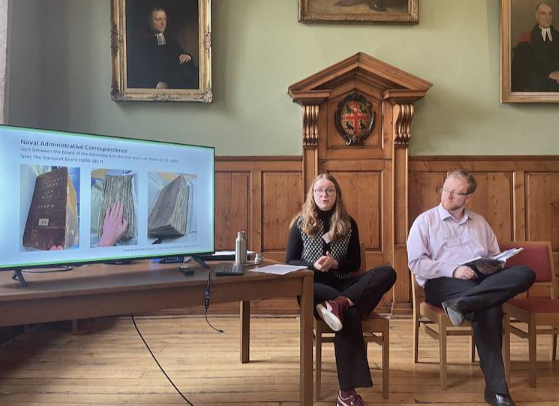
The following day, a panel on Nutrition science drew attention to the common wartime problem of feeding populations in ways which were culturally acceptable. Manon C Williams provided insights into the British Royal Navy’s many food preservation innovations and the quest to make such food palatable. Jonathan Slater continued the theme of palatability with an examination of ersatz food developed in Germany during the First World following shortages resulting from the Anglo-French blockade. Charly Rehnert discussed how Nazi preoccupation with vitamins resulted in scientific knowledge about vitamins being relayed in German cookbooks.
The final panel considered the role of medical, humanitarian and military communities and authorities in shaping taste during the First World War. Maxime Guesnon looked at doctors’ promotion of wholemeal bread in the context of debates about the relative nutritional and caloric values of white versus brown bread. Alexandros Touloumtzidis outlined the relationship between rationing and labour productivity in Macedonia as implemented by the British Salonika Force and the wider impact of rationing on food circulation. Nel de Mûelenaere discussed a survey of children’s health in post-war Belgium and the failures of post-war humanitarianism, in contrast to its wartime success.
The conference was generously supported by the International Society for First World War Studies (https://firstworldwarstudies.org/ ) and St Edmund Hall, Oxford.