“The father's place in education [is] so important, though by no means easy to define."
Conceptions of fatherhood in the Parents’ Review
16 September 2026
Michael Williams (UNIQ+ Research Intern 2026)
Michael Williams is a fourth-year History and Politics undergraduate student at the University of Edinburgh, with a keen interest in the history of fatherhood and masculinity.
At the third annual conference of the Parents’ National Education Union (PNEU) in May 1899, historian and educationalist Michael Ernest Sadler argued that the father’s influence in the education of young children was “generally a bad second”.[i] The chairman, Reverend Robert Forman Horton, immediately challenged him: “I think that the father’s influence is most important in education, and that if it is not – well, it ought to be.”[ii]
Horton’s intervention reveals an important insight into PNEU conceptions of fatherhood at the turn of the twentieth century. Contrary to John Tosh’s argument that upper- and upper-middle-class fathers became increasingly detached from family life in the late Victorian and Edwardian period, the PNEU's journal, Parents’ Review, repeatedly encouraged fathers to take their role in their children’s education seriously.[iii]
Historians who have challenged Tosh have often located the origins of involved fatherhood elsewhere. Claudia Nelson has linked it to companionate marriage, while Stephanie Olsen has emphasised evangelical teachings about the father’s responsibility for children’s religious education.[iv] However, the Parents’ Review reveals another influence: progressive pedagogical ideas.
These ideas can be summarised as follows:
- Education begins in the home.
- The ultimate aim of education is the formation of moral character.
- Character and self-control are formed through habit.
- Character determines destiny.
This blog post argues that these principles shaped the journal’s conception of fatherhood. Because character formation lay at the heart of education, PNEU fathers were expected to contribute positively to their children’s moral development, manage the surrounding influences, and discipline them in ways that strengthened self-control.
Firstly, fathers were expected to be role models in their children’s moral education. Although mothers were generally seen as the dominant influence during early childhood, fathers were seen to become increasingly influential as children grew older. This reflected the PNEU’s belief that character developed largely through observation and imitation. Henry E. Victor argued that children are most influenced by what “they see and hear at home,” especially “from their father and mother,” while William Joseph Tyson described the child as “essentially an imitator.”[ix]
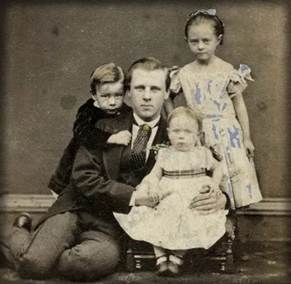
This understanding of development created a new responsibility. Fathers could not expect their children to acquire virtuous characters unless they demonstrated virtue themselves. Reverend Robert Eyton argued that parents should live in such a way that they would wish their children to follow their example, while Colson insisted that fathers must make their lives “a pattern to their children.”[x] Fathers were therefore conceptualised as part of the home educational environment through which character was formed.
Secondly, fathers were expected to ensure that their children were exposed to the best external influences. In practice, this meant fathers were encouraged to choose schools whose values aligned with those of the home, and which suited the individual child. John Haden Badley argued that parents should ensure consistency between home and school values, while Agatha Goodhart criticised fathers who selected schools “without any reference to the boy’s tastes or inclinations.”[xi] Teachers were also believed to exercise considerable influence over character. Consequently, Colson advised fathers to choose teachers whose lives and characters are “beyond reproach."[xii] However, paternal responsibility did not end once a child entered school. Fathers were expected to remain engaged in their children’s education. Tyson, for example, warned that excessive schoolwork pushed the brain “beyond its capabilities” and could damage children’s physical development.[xiii]
The Parents’ Review also encouraged fathers to help sons navigate the moral challenges of school life. Badley advised fathers to cultivate relationships in which sons felt able to confide in them about the “dangers and trials” of boarding school.[xiv] Dr Marion Hunter similarly argued that boys who learned about sex from their fathers would associate the subject with “something especially sacred.”[xv] Close paternal relationships were therefore presented as a means to protect character and guide children’s moral development.
Thirdly, fathers were encouraged to discipline children in ways that strengthened self-control rather than relying on harsh punishment. Corporal punishment was often criticised because it was believed to undermine character formation. J. Meldrum Dreferre urged fathers: “Be gentle with your children,” while Thomas Godolphin Ropper warned that severe discipline “makes children harsh and unsympathetic in adult life.[xvi]
The PNEU also feared that severe discipline encouraged obedience based on fear rather than moral understanding. One anonymous father writing in the journal observed: “Obedience through fear is a poor thing.”[xvii] Harsh discipline could further damage trust between father and child. Reverend John Harry Miller argued that without a child’s trust, “you need not try to influence him.”[xviii]
The ultimate aim of discipline for the PNEU was not submission but self-mastery. As William John Greenstreet explained, fathers should not use discipline “to break the child’s will; we want to strengthen it and direct it.”[xix] Rooper similarly argued that when children eventually leave home, the most valuable aspect of their moral training is that which “has led to self-mastery.”[xx] Progressive discipline, therefore, redefined both the methods and the purpose of paternal authority.
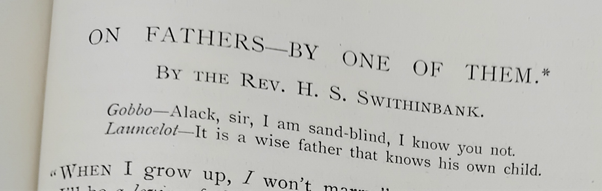
Christianity was also frequently used to underpin these educational ideas. PR writers argued that progressive methods reflected God’s design for child development. Elinor A. Welldon claimed: “God has given this imitative power to the child as a means for self-development,” while Reverend Herbert Spenser Swithinbank argued that each child possessed a God-given “self-determining will” that parents must train.[xxi] Progressive educational practice could therefore be presented not as a challenge to religious values, but as a means of fulfilling them. Involved fatherhood was presented as a prerequisite to that end.
The Parents’ Review subsequently complicates the prevailing picture of the Victorian father as increasingly withdrawn from family life. PNEU fathers were expected to model virtue, choose and monitor educational environments, and discipline children in ways that taught moral willpower. By linking education to character formation, the journal encouraged fathers to recognise their influence on their children’s development. What the Parents’ Review reveals is that progressive educational ideas fostered a conception of involved fatherhood that ran counter to the idea of paternal detachment in this period.
[i] Anon., “Annual Conversazione,” Parents’ Review, vol. 10 (1899), p. 477.
[ii] Ibid.
[iii] John Tosh, A Man’s Place: Masculinity and the Middle-Class Home in Victorian England (New Haven, Connecticut: Yale University Press, 1999), 93. See also John Tosh, “Home and Away: The Flight from Domesticity in Late-Nineteenth Century England Re-Visited.” Gender & History 27, no. 3 (2015): 562. doi:10.1111/1468-0424.12150
[iv] Claudia Nelson, Invisible Men: Fatherhood in Victorian Periodicals, 1850-1910 (Athens; University of Georgia Press, 1995), 47-8; Stephanie Olsen, “The Authority of Motherhood in Question: Fatherhood and the Moral Education of Children in England, c. 1870-1900” Women’s History Review 18, no. 5 (2009): 769 doi:10.1080/09612020903282118.
[ix] Henry E. Victor, “The Home Teaching of Religious Truth,” Parents’ Review, vol. 12 (1901), p. 15; William Joseph Tyson, “On True Education,” Parents’ Review, vol. 8 (1897/98), p. 17.
[x] Robert Eyton, “Religious Education of Young People,” Parents’ Review, vol. 3 (1892/93), p. 561; Francis Henry Colson, "Plutarch On the Training of Children”: The Earliest Extant Essay on Home Education," Parents' Review, vol. 1 (1890/91), p. 325.
[xi] John Haden Badley, "Moral Teaching at School," Parents' Review, vol. 16 (1905), p. 522; Agatha M. Goodhart, "A Father's Influence," Parents' Review, vol. 8 (1897), p. 170.
[xii]Francis Henry Colson, "Plutarch On the Training of Children”: The Earliest Extant Essay on Home Education," Parents' Review, vol. 1 (1890/91), p. 325.
[xiii]William Joseph Tyson, “On True Education,” Parents’ Review, vol. 8 (1897/98), p. 17.
[xiv]John Haden Badley, “The Father’s Place in Education,” Parents’ Review, vol. 12 (1901), p. 621.
[xv] Dr Marion Hunter, “Moral Training of Children up to School Age,” Parents’ Review, vol. 16 (1905), p.518.
[xvi]J. Meldrum Dreferre, “The Moral and Religious Training of Children, Parents’ Review, vol. 5 (1894/95), p. 73; Thomas Godolphin Rooper, “On Spencer’s “Education”,” Parents’ Review, vol. 10 (1899), p. 617.
[xvii] Anon., “Extracts From a Father’s Diary,” Parents’ Review, vol. 2 (1891/92), p. 902.
[xviii]John Harry Miller, “A Boy’s Religion,” Parents’ Review, vol. 12 (1901), p. 241.
[xix]William John Greenstreet, “Morals in the Home,” Parents’ Review, vol. 2 (1891/92), p. 93.
[xx] Thomas Godolphin Rooper, “Be Good: or –” (Nursery Ethics),” Parents’ Review, vol. 1 (1890/91), p. 423.
[xxi]Elinor A. Welldon, “Frobel’s Principles Applied,” Parents’ Review, vol. 1 (1890/91), p. 26; Herbert Spenser Swithinbank, “On Fathers – by One of Them,” Parents’ Review, vol. 9 (1898), p. 761-2.