
Death, Grief, and the Family during and after the First World War, 1914-1920
16 September 2026
By Grace Pamplin (UNIQ+ Research Intern 2026)

Photo credit: Charlie Byng.
Grace Pamplin was a research intern at the University of Oxford this summer through the 2026 UNIQplus programme. Under the supervision of Christina de Bellaigue and Julia Gustavsson, she developed this project looking into how grief emotionally impacted the family during the First World War, and how periodicals of the time advised families on how to deal with their grief. Grace holds a First Class BA (hons) in History from the University of Reading, and is due to start her MA in History at University College London this September. Her research mainly focuses on the cultural impact of the AIDS epidemic in Britain, as well as public perceptions surrounding both the virus and homosexuality during this time.
Grief is a complex state of feeling that we will all experience in our lifetime. Yet the historiography has rarely analysed grief, including in the context of the family during the First World War. Research on the family during that period has predominantly focused on changing structures and family roles, with great emphasis being placed on the declining fertility rate and its impact on family size, rather than the emotional aspects of the family unit.1 While a history of emotions is emerging, Michael Roper details how ‘subjective experience is placed at the edge of historical analysis’.2 This can be clearly seen in historiography surrounding the First World War, with Amy Shaw arguing that ‘there is an absence of mourning in our history of the war’3. Historians such as Thomas Dixon are starting to change this by focusing on sadness, grief, and specifically crying through a historical lense, yet more research still needs to be done that takes emotional experiences as seriously as historical fact.4
This blog post seeks to bridge the gap between emotional history and the history of the family during the First World War. It analyses accounts of familial grief and advice given to parents found in The Parents’ Review: a monthly periodical edited by education reformer Charlotte Mason. My research suggests that periodicals during the First World War advised families to repress their grief by justifying deaths during the war in the name of duty and sacrifice. This not only upheld the ‘stiff upper lip’ mentality newly expected of mothers, but also set high expectations for sons to aspire to. Periodicals also emphasised religion as a coping mechanism for the loss of children gone too soon. In terms of educating children about grief, Periodicals debated whether to educate them about the horrific realities of war or whether to preserve their childhood innocence.
Grieving Mothers and Repression
Traditionally, mothers were viewed as the emotional crux of the family, especially in contrast to the stoic father. However, during the war, this emotionality was viewed as a weakness, and in order to be taken seriously at a time when women were fighting for the right to vote and entering the workplace, they had to appear to be less emotional. As Thomas Dixon states ‘if women in Britain in the twentieth century wanted to start working – and voting – on equal terms with men, they were going to have to stop weeping’.5
This arguably had an impact on the advice given to mothers about handling grief in The Parents’ Review. Stewart D. Headlam’s May 1918 article ‘Some Old Words About the War’ advises mothers by saying ‘the main thing you have to do is yourselves to keep cheerful and to keep fit’.6 He also states that ‘we have for too long been in the habit of depreciating ourselves, talking as if “muddling through” was the only process of which we were capable’.7 This implies that parents should not openly grieve, but instead mask their sorrow and continue on with their lives as normal. This advocates for the repression of sadness and grief, and does not allow parents to feel, potentially since they may have other children that they need to provide on. Similarly, in October 1918 another article shared the same sentiment by recommending ‘not let our sorrow be so excessive as to give them undue pain’.8
Many of the writers for The Parents’ Review used religion to comfort families in mourning. Rev. J. Hawkesworth says ‘the dear lads we mourn and miss are now basking in God’s love’.9 F.M.H writes in a separate article ‘but surely there is still work for those eager young spirits, their lives are only ended as far as the material body is concerned, they have but transferred their activities to another sphere’.10 This suggests that authors used religious language to argue that those who lost their lives in the war now have a duty to God in Heaven. This was meant to comfort families, particularly mothers, by convincing them that their child’s death was part of God’s wider plan for humanity.. This use of Protestant language and concepts , therefore, demonstrates how pervasive religious ideology was in the daily lives of upper and middle-class families.
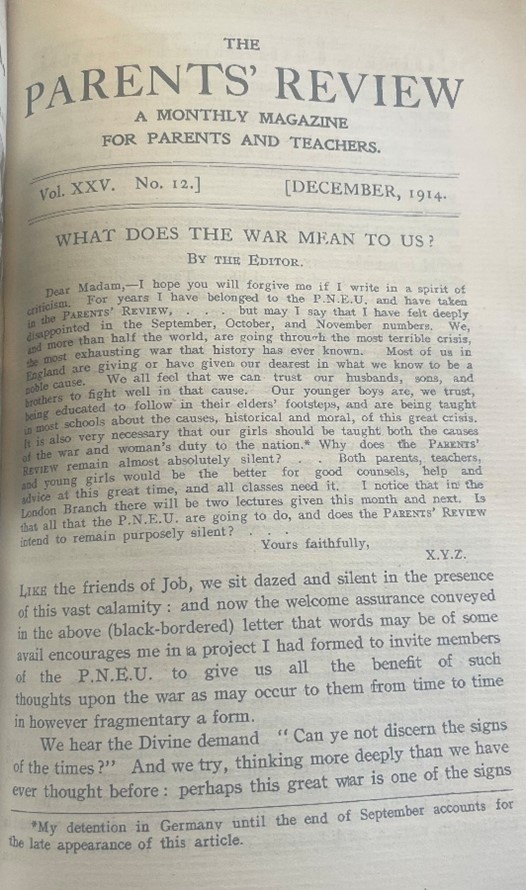
Figure 2: First Page of article ‘What does the war mean to us?’ by Charlotte Mason. C. Mason, ‘What does the war mean to us?’, The Parents Review, ed. C. Mason, vol. xxv (London, 1914), p. 849
Duty and the Expectations placed on Sons
A pattern that emerged between articles discussing death and grief caused by the war was the use of duty as a justification for the deaths of young men on the front lines. Charlotte Mason’s December 1914 article ‘What does the war mean to us?’ asks its readers ‘can a man die better than in his country’s service, and is there any assuaging of a woman’s sorrow equal to that of knowing that the beloved one has died a hero’s death?’.11 Mason here argues that parents should not feel sad over their loved one’s deaths if they were in the name of duty, andshould instead feel proud that they served their country and sacrificed themselves This also implies that sons should aspire to die a hero’s death.
In the April 1917 article ‘“In memory of a young officer”, its author, an unnamed mother who may have been real or invented by Mason, utilises this line of thinking when she says ‘It will be just a year since my beloved boy gave up his gallant young life for his country’.12 She describes the memory of her son positively, and emphasises his strength, courage and bravery: attributes that society expected men to have. This implies that this article is not just about a mother grieving her son, but also offers a lesson in the values that sons should aspire to.
What is interesting is that The Parents’s Review also published criticism of the idealisation of war and dying in the name of duty. In the January 1917 article ‘Children and the War’, Lilian Stevenson argues ‘‘Dulce et decorum est pro patria mori’; yes, but it is a dying of which the other side is killing’.13 This phrase translates to “It is sweet and proper to die for one's country”, and derives from the Roman poet Horace’s ‘Odes’. It is also the title of a Wilfred Owen poem, which describes the harsh conditions that soldiers were fighting in, and condemns the romanticisation of war. Stevenson, by referencing this well-known saying, exposes the limitations of justifying the deaths caused by war through concepts of duty. Because regardless of whether these boys died for their country, they still died, and they were still killed by someone else. This implies that their deaths were instead avoidable and unnecessary. The fact that The Parents’ Review published this opinion reveals that the progressive Parents Review did allow for the expression of alternative views.
Educating Children on Grief and Suffering
A key debate arising in The Parents’ Review was the question of how to educate children about the horrors of war, and the grief that war causes. This is exemplified in the January 1917 article ‘Children and the War’ by Lilian Stevenson. She argued that ‘can we not keep the darker side from them – let them play at soldiers and follow the band, let them see the glamour and the glory, and hide the horror and the shame in our own hearts?’.14 This is possibly suggestive of the opinions of many of the parents reading the review, that were hesitant to corrupt their children by teaching them about the harsh realities of the war. However, Stevenson opposes this, saying ‘if they are to build the future, let them think of war gravely and truly’.15 This implies that Stevenson saw the education of children on these hard topics as a positive that would enrich their knowledge rather than hinder it.
Stevenson also argued that ‘personal sacrifice the child too can dimly understand, because even the children all know someone who used to play with them who has laid down his life at the front’.16 The majority of children at this time would have experienced the effects of war in some form, whether that be by losing family members or friends, or hearing stories from other children and families. Therefore, she suggested it would be better for children to be fully educated on the events and emotions that they were experiencing, rather than live in confusion and ignorance? Stevenson’s article does not give us a concrete answer to this debate, perhaps leaving it up to families to decide what is best for their own children, but her focus on understanding things from the perspective of the child, and respect for the child’s understanding, reflects the principles of progressive parents and educators like those who engaged with the Parents Review who adopted child-centred methods
In conclusion, the ways grief is portrayed and the advice given to grieving families in The Parents’ Review were just as complex as the emotions of grief itself. While it did focus on themes of duty, sacrifice, emotional containment, and protecting children, The Parents’ Review did allow space for divergent and more nuanced responses to grief and the war. This was reflective of the principles of Mason and the PNEU, as well as the parents and educators who adopted these views and engaged with The Parents’ Review and its advice.
Footnotes
[1] See L. Davidoff, The family story: blood, contract and intimacy, 1830–1960 (London, 1999)., S. Grayzel, Women’s identities at war: gender, motherhood, and politics in Britain and France during the First World War (Chapel Hill, 1999)., C. Nelson, Family Ties in Victorian England (London, 2007)., S. Pooley, ‘Parenthood, child-rearing and fertility in England, 1850-1914’, History of the Family, vol. 18 (2013), pp. 83-106.
[2] M. Roper, ‘Slipping out of view: Subjectivity and Emotion in Gender History’, History Workshop, vol. 59 (2005), p. 62.
[3] A. Shaw, ‘Expanding the Narrative: A First World War with Women, Children, and Grief’, The Canadian Historical Review, vol. 95 (2014), p. 403.
[4] T. Dixon, Weeping Britannia: Portrait of a Nation in Tears (Oxford, 2015). See also P. Jalland, Death in War and Peace: A History of Loss and Grief in England, 1914-1970 (Oxford, 2010).
[5] Dixon, Weeping Britannia, p. 217.
[6] S. D. Headlam, ‘Some Old Words About the War’, The Parents’ Review, ed. C. Mason, vol. xxix (London, 1918), p. 329.
[7] Headlam, ‘Some Old Words About the War’, p. 332.
[8] Rev. J. Hawksworth, ‘Lift Up Your Hearts (From one mourner to another)’, The Parents’ Review, ed. C. Mason, vol. xxix (London, 1918), p. 575.
[9] Hawksworth, ‘Lift Up Your Hearts (From one mourner to another)’, p. 571.
[10] F. M. H., ‘The Children who have Gone Before’, The Parents’ Review, ed. C. Mason, vol. xxxi (London, 1920), p. 55.
[11] C. Mason, ‘What does the war mean to us?’, The Parents’ Review, ed. C. Mason, vol. xxv (London, 1914), p. 856.
[12] ‘“In memory of a young officer” by his mother’, The Parents’ Review, ed. C. Mason, vol. xxviii (London, 1917), p. 297.
[13] L. Stevenson, ‘Children and the War’, The Parents’ Review, ed. C. Mason, vol. xxviii (London, 1917), p. 48.
[14] Stevenson, ‘Children and the War’, p. 45.
[15] Stevenson, ‘Children and the War’, p. 45.
[16] Stevenson, ‘Children and the War’, p. 46.
Bibliography
Primary Material
The Parents’ Review, ed. Mason, C., vol. xxv (London, 1914).
F. M. H., ‘The Children who have Gone Before’, The Parents’ Review, ed. Mason, C., vol. xxxi (London, 1920).
Hawksworth, Rev. J., ‘Lift Up Your Hearts (From one mourner to another)’, The Parents’ Review, ed. Mason, C., vol. xxix (London, 1918).
Headlam, S. D., ‘Some Old Words About the War’, The Parents’ Review, ed. Mason, C., vol. xxix (London, 1918).
‘“In memory of a young officer” by his mother’, The Parents’ Review, ed. Mason, C., vol. xxviii (London, 1917).
Mason, C., ‘What does the war mean to us?’, The Parents’ Review, ed. Mason, C., vol. xxv (London, 1914).
Stevenson, L., ‘Children and the War’, The Parents’ Review, ed. Mason, C., vol. xxviii (London, 1917).
Secondary Literature
Davidoff, L., The family story: blood, contract and intimacy, 1830–1960 (London, 1999).
Dixon, T., Weeping Britannia: Portrait of a Nation in Tears (Oxford, 2015).
Grayzel, S., Women’s identities at war: gender, motherhood, and politics in Britain and France during the First World War (Chapel Hill, 1999).
Jalland, P., Death in War and Peace: A History of Loss and Grief in England, 1914-1970 (Oxford, 2010).
Nelson, C., Family Ties in Victorian England (London, 2007).
Pooley, S., ‘Parenthood, child-rearing and fertility in England, 1850-1914’, History of the Family, vol. 18 (2013), pp. 83-106.
Roper, M., ‘Slipping out of view: Subjectivity and Emotion in Gender History’, History Workshop, vol. 59 (2005), pp. 57-72.
Shaw, A., ‘Expanding the Narrative: A First World War with Women, Children, and Grief’, The Canadian Historical Review, vol. 95 (2014), pp. 398-406.