

Death, Grief, and the Family during and after the First World War, 1914-1920
3 November 2026
By Ceyhan Topal (UNIQ+ Research Intern 2026)

Ceyhan Topal was a researcher at the University of Oxford in the 2026 UNIQplus programme. As part of the ‘Conservatism in the Atlantic World in the Nineteenth-Century’, project supervised by Professor Adam I.P Smith and Dr Robin M. Bates, his project focused on the language of conservatism, especially how British newspapers used such language during moments of international crisis. Ceyhan is currently an MSc student in History of International Relations at the London School of Economics and Political Science. He holds a First-Class BA (Hons) in History from the University of Kent, where his research interests broadly encompassed nineteenth-century diplomatic history, particularly Anglo-Ottoman relations in the Napoleonic era. His current research continues to centre on Anglo-Ottoman relations, pivoting toward the Eastern Question in the early to mid-nineteenth-century.
Concluding nearly two decades of continental warfare, the Congress of Vienna and its balance-of-power logic came to dominate the foreign policy calculations of Europe’s “Great Powers” throughout the nineteenth-century. Such a logic has been understood as conservative, yet such a normative reading of conservatism obscures the nuanced and contrasting deployment of the term by contemporary commentators, above all newspaper editors but also, as reported in their columns, diplomats and cabinet ministers. My research, in conjunction with the ongoing Leverhulme-funded project ‘Conservatism in an Age of Revolution’, sought to uncover how British commentators deployed the language of conservatism in moments of international crisis.
The notion of international crisis, in this instance, refers to a period of heightened international tension in which the existing political order appeared sufficiently unstable as to demand political action. Crisis moments therefore serve as a rich field of inquiry because they forced governments and political actors not only to reassess the principles of that order, but to determine what action was necessary to preserve it. In such moments, the language of conservatism was not a homogeneous descriptor of Conservative Party policy nor was it a programme of non-interventionist anti-liberalism. Instead, the terminology functioned as language of legitimation. British commentators would use the language of conservatism to claim that a particular policy or institution presumed to preserve political order. However, to be conservative, a policy or institution did not necessarily need to be “Conservative”.
What we may nominally understand as “Whig” or “liberal” could be conservative if the product of its action was preserving of order. Conservatism was therefore less a fixed ideological position than a flexible language through which political actors could define, defend, and contest the boundaries of legitimate political order. Its meaning was essentially relational; what counted as conservative depended upon what was perceived to be under threat, and whether a given policy was understood to preserve or disrupt the existing order. British commentators did not necessarily invoke conservatism to advocate the restoration of an imagined ancien régime, nor did they invariably use it to oppose political change.[i] Rather, the term could legitimise coercive intervention, diplomatic accommodation, or geopolitical realignments when these were presented as necessary to prevent greater disorder. The language of conservatism consequently provides a valuable means of examining how contemporaries defined the political order they sought to preserve, and who or what they believed was capable of preserving it.
The Eastern Crisis (1839-41) presents a uniquely acute moment of crisis because it threatened both the integrity of the Ottoman Empire as well as the overarching diplomatic equilibrium of Europe, forcing contemporaries to defend radically realigned foreign policy. The immediate conflict was triggered by Sultan Mahmud II’s renewed attempt to enact revenge upon his renegade governor, Mohammed Ali of Egypt, who invaded and occupied Syria and Adana during the First Turco-Egyptian War (1831-33).[ii] Yet, the situation rapidly escalated into a wider European question. Ottoman weakness, certainly after the Battle of Nezib (1839) and defection of the bulk of the Ottoman navy, posed a threat to the European balance-of-power. Russian influence at the Porte, French support of Mohammed Ali and Britain’s increasingly established interest in maintaining the Ottoman Empire as a buffer to India were just some of the interests at hand in this conflict.[iii] When Britain, Russia, Austria and Prussia concluded the Convention of London in July 1840, the resulting Quadruple Alliance placed France outside of the settlement and had, in effect, up-ended the liberal entente between Britain and France.[iv] This left Britain aligned with the three eastern powers of the Holy Alliance, described by Joseph Hume as ‘the despots of Europe’ with a ‘name now so odious’.[v]
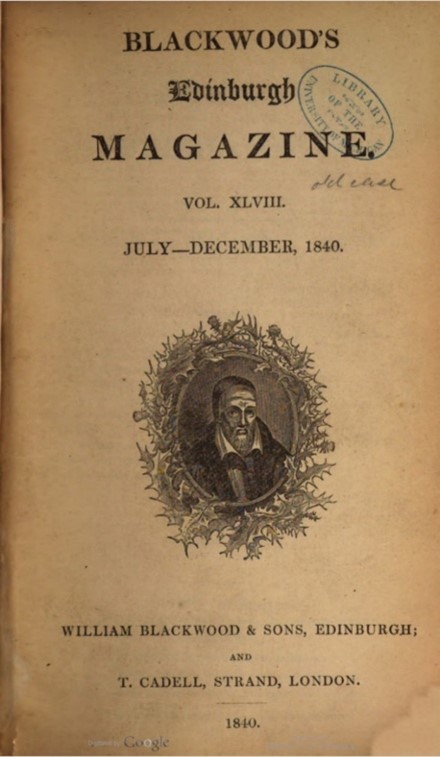
Despite defying George Canning’s ostensibly non-interventionist policy and what P.E Caquet described as ‘old Whig Francophilia, especially of the Foxite strand’, Lord Palmerston’s actions were understood by TheMorning Post to be ‘the best way to maintain the Conservative principles in Europe’ in November 1840.[vi] Similarly, the Blackwood’s Magazine described Britain’s newfound alliance as part of a broader conservative effort to halt ‘the insidious progress of political degeneracy’ in the face of France’s 'oriental phantasmagoria'.[vii] Whether a policy was judged prudent and conducive of order, or reckless and incendiary rested on the crucial question of what precisely was to be preserved.
During the Eastern Crisis, the answer to this question manifested in the contrasting perceptions of Egypt and the Ottoman Empire. By the late 1830s Mohammed Ali’s regime was increasingly interpreted as an alternative model of political development in the Near East; associated with centralisation, a westernisation of the military and the introduction of French values of civilisation.[viii] As well as being attractive to France, Egypt represented a potential economic partner for Britain and posed a threat to her relations with the Sultan.[ix] For the likes of Lord Holland and Earl Grey, the Ottoman Empire was stagnating and beyond the point of recovery, instead believing Britain’s focus should be turned to the Belgian and Spanish Questions.[x] Yet, despite divisions within the Cabinet, Palmerston championed a foreign policy of Ottoman regeneration grounded in Sultan Abdülmecid I’s 1839 Hatti Şerif of Gülhane which inaugurated the Tanzimat reforms.[xi] The Hatti Şerif offered the possibility that Ottoman institutions could be strengthened without being dismantled and saw British policy rest upon the objective of preservation through regeneration.
The competing visions of political order generated by the crisis were not confined to Britain but also appear in discussions of French foreign policy. In an article from The Standard, it was explicitly declared that François Guizot’s policy of allowing a ‘quiet and unmolested’ destruction of the Ottoman Empire was fundamentally ‘not conservatism’.[xii] Allowing Ottoman weaknesses to accommodate Egyptian expansion and increased Russian influence at the Porte would itself threaten the wider European settlement and was thus not conservative. With that logic in mind, a later article from The Standard described Britain’s involvement in the conflict as a ‘Conservative war’: where the active suppression of Mohammed Ali’s conquests constituted a conservative policy.[xiii] Similarly, Alphonse de Lamartine declared in the Chamber of Deputies that France should pursue a policy of military intervention in Syria; one in conjunction with the European powers that, much like the Napoleonic Wars, would finalise a settlement with a congress in Vienna.[xiv] Such was the delight of The Morning Post to report this news that Lamartine was proclaimed ‘the champion of Conservatism against Liberalism’.[xv] In The Standard and The Morning Post then, the defence of the Ottoman Empire was framed as the legitimate application of conservative principles. Conservatism, in this sense, denoted not opposition to change per se, but the preservation of political equilibrium against forces perceived to threaten it.
Here exists a crucial distinction between preserving an order and preserving the status quo. Political structures could be reconstructed in order to prevent their collapse, but the legitimacy of change depended on whether it truly secured, rather than disrupted, the wider order. Consequently, the language of conservatism freely transcended traditional political divisions. Palmerston could be praised in The Standard as upholding the ‘Conservative principles of Europe’ despite his Whig allegiance, indeed, his experience in government was suggested to have ‘compelled him to perceive that Conservative policy is the better course’.[xvi] Such praise was also extended to Britain’s Ambassador to the Porte, the Whig Lord Ponsonby, who was praised for championing the 'principles of Conservatism' because of his refusal to engage in 'those petty diplomatic questions, which like petty wars produce neither honour nor profit to a nation'.[xvii] Contemporary commentators could therefore rally behind traditional political opponents, invoking the language of conservatism if that individual implemented their preferred policy.
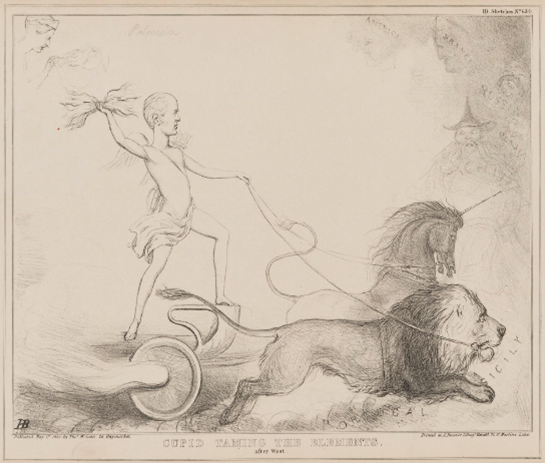
Notwithstanding newspaper opinions or cabinet objections, Palmerston held a commanding grip on the direction of foreign policy and domestic debates rapidly shifted away from whether Britain should intervene, toward how it could responsibly do so.[xviii] The Norfolk Chronicle presented military intervention and an imposed settlement as a legitimate policy to preserve Ottoman independence, while Benjamin Disraeli – as reported by The Standard – argued that a willingness to isolate France risked the very European war that conservative prudence was supposed to prevent.[xix] The language of conservatism thus emerged as a battleground of competing justifications for policy direction. To claim that a policy was “conservative” was to claim that it represented the prudent defence of a legitimate order. Simultaneously, it implied that its opponents were endangering said order, transforming the language of conservatism into a tool that could equally legitimise or delegitimise. Unsurprisingly, little consensus existed on what a legitimate order or its defence consisted of, leading to dramatic disparities between different invocations of conservatism.
Perhaps more than any other “Great Power”, Russia presented the most polarised deployment of the language of conservatism. The Worcestershire Chronicle, for example, denounced Tsar Nicholas I as ‘one of the pillars of conservatism in Europe’ for his staunch despotism, orthodoxy and cultural suppression of national minorities.[xx] Where The Times argued that Europe’s financial and political troubles stemmed from a ‘temporary depression of the Conservative cause’, the Fife Herald refuted such a conclusion in its article ‘Financial Embarrassments of Europe and the Democratic Tendency’.[xxi] The publication identified that in Russia, ‘the Conservative cause has undergone no depression’ and therefore its despotism was unchecked; ‘save by the Sash’.[xxii] Indeed, Russia had accumulated massive debts waging aggressive wars against the Ottomans and Persians throughout the 1820s. Yet, The Standard explicitly rejected conceptions linking despotism and conservatism. If conservatism was to imply a preference for absolutist power, The Standard would refuse to identify with it; true adherence to conservatism instead required a commitment to constitutional systems rather than autocratic rule.[xxiii] Across the British press then, Russia was both conservative for its defence of European order and simultaneously a conservative source of instability and despotism.
The curious case of Russia thus unveils the underlying fragmentation of conservatism as a political concept because each major publication held distinct, if sometimes overlapping, assumptions about what constituted conservatism. The Standard, for instance, appears to have understood conservatism through the preservation of political order rather than preconceived notions of conservative actions.[xxiv] The rejected association of despotism and conservatism was significant because it demonstrated that the publication did not locate conservatism in any particular political form. A constitutional government could be conservative if it represented an established and legitimate political authority while the preservation of the autocratic Ottoman Empire could likewise be conservative as its continued existence was perceived to be necessary to the balance-of-power.
The Morning Post approaches the same concept from a markedly different direction. Its definition of conservatism placed considerable emphasis upon 'obedience to the laws', 'moderation of hope', 'resignation under the imperfections of our nature' and 'contentment with our lot'.[xxv] Where The Standard simply championed preservation, the Morning Post instead located true conservatism in the disposition required to govern a stable order. To this end, the publication pitted conservatism against radicalism due to the latter’s perceived excessive expectation and unwillingness to accept political realities.[xxvi] This conception allowed the paper to present the foreign policy of Sir Robert Peel as compatible with conservative principles because it aligned with the pragmatic moderation that the Morning Post regarded as constitutive of conservatism.[xxvii]
This alludes to something which further distinguishes the Morning Post from other publications; its use of conservatism to survey the Conservative party. In an 1840 article, the language of conservatism was explicitly used to bifurcate the Conservative party by separating the ‘old aristocratical Tories... descendants from Lord Castlereagh’ from the ‘moderate Tories, who resist by a spirit of conservatism the movement of the Reform party.’[xxviii] Led by Peel, this moderate conservatism was defined by its pragmatic flexibility rather than historic aristocratic ‘prejudices’.[xxix] The article framed this ‘spirit of conservatism’ not as an unyielding attachment to past geopolitical feuds, but as a rational disposition capable of embracing a ‘close alliance’ with France.[xxx] In uniting the two nations, this brand of conservatism sought to navigate the diplomatic fallout of the Convention of London and preserve the fragile ‘peace of Europe’ through cooperation unhindered by ideological differences.[xxxi]
This use of the language of conservatism directly conflicts with the Morning Herald’s ‘real conservatism’, which positioned itself as autonomous of political binaries. The Morning Herald declared that despite being an ‘organ of Conservative opinions’, had no implicit or servile adherence to any political leadership in the state.'[xxxii] The publication stated:
'Having, as a journal devotedly attached to the principles of constitutional monarchy, laboured long in behalf of what we considered real Conservatism, we have thought it right on many occasions to meet the slanderers of the Conservative cause with a practical refutation of their favourite lie — that the word ‘ Conservatism,’ as representing certain political opinions in this country, implies a hatred of free government and a sympathy with despotic power.'[xxxiii]
The Morning Herald, much like The Standard, rejected the connection between conservatism and despotism. Instead, it explicitly tied ‘real conservatism’ to an order which rested upon legitimate constitutional principles. Whereas the Morning Post located its conservatism in the dispositional sense, the Morning Herald saw conservatism in a manner that transcended the political actor and focused on the constitutional legitimacy of the order itself.
The Fife Herald offers an equally interesting definition of this divisive term, contending that conservatism sought 'to uphold the dead letter of the law without regard to the living spirit of society', remarking that the source of many issues for the 'Governments of Europe…is their unfortunate opinion that they must resist and control the tendencies of society'.[xxxiv] This conception of conservative politics critiques the core logic of preservation which treated the continuation of existing institutions as an end in itself rather than as a means of maintaining a functional body politic. The criticism therefore poses an important question: did true conservatism mean preserving institutions because they continued to serve society, or preserving them because they were already established?
For Fraser's Magazine, the endurance of an institution is what underpinned its legitimacy and need for preservation. The periodical’s discussion of the ‘conservative characteristics’ of the Ottoman Turk rested upon qualities of historical continuity, inherited institutions and attachment to an established political identity.[xxxv] The Ottoman Empire could be admired precisely because its political character was understood as the product of historical development, even while the Empire's contemporary weaknesses were acknowledged. Conservatism here acquired a distinctly historical dimension: what deserved preservation was not simply an existing government, but the accumulated political character of a society; a concept strongly reminiscent of Edmund Burke’s stance on historical continuity.[xxxvi] Although the Fife Herald's critique demonstrates that this principle was by no means universally accepted, there still existed a conception of conservative legitimacy anchored in historical lineage. Indeed, Blackwood's Magazine extended this historical conception beyond individual states and towards an explicitly international understanding of conservatism. Its references to the great conservative powers of Europe and the defeat of Napoleon Bonaparte as an ‘act of conservatism’ suggest that it understood political order as something actively constructed and defended by states possessing both the authority and responsibility to preserve it.[xxxvii]
Throughout the Eastern Crisis then, the language of conservatism was as widespread in its use as it was ambiguous. Each publication disagreed about the character, logic and implementation of conservative language to the extent that entire articles were dedicated to exploring the abstract meaning of conservatism. What transcends almost all of this vast literature, however, is the use of conservatism as a language of (de)legitimation. The invocation of conservatism thus held the function of (de)legitimising institutions, policies or individuals. Whether it be the lauding of a letter, 'perfectly in accordance with the principles of Conservative European policy', sent by Palmerston to the ambassador to France or the Times demanding the Foreign Secretary 'return to his old Conservative principles' lest Britain be left as Disraeli described as ‘without an ally in Europe’.[xxxviii] Less an ideological concept than a political tool, the language of conservatism during the Eastern Crisis held a distinctly elastic character.
[i] This is not to say that idea of imagining and re-inventing the ancien regime was not in circulation at this moment, as per Ambrogio A. Caiani, ‘Re-inventing the Ancien Régime in Post-Napoleonic Europe’ European History Quarterly, 47(3),442
[ii] P.E. Caquet, ‘The Orient, the Liberal Movement, and the Eastern Crisis of 1839-41’ (London: Palgrave Macmillan, 2016), 52
[iii] For an in-depth exploration of the crisis and the motivations of each European power, see; Caquet, ‘The Eastern Crisis’, passim; M.S. Anderson ‘The Eastern Question 1774-1923’(London: Macmillan, 1963), passim.
[iv] The Convention of London, signed July 15, 1840, saw the Great Powers jointly agree to protect Sultan Abdülmecid against Mohammed Ali but in return ‘the Straits would be closed in peace-time to the warships of all foreign states’ as per Anderson, ‘The Eastern Question’, 101; Caquet, ‘The Eastern Crisis’, 39; Caquet, ‘The Eastern Question’, 3
[v] Formed in 1815 by Tsar Alexander I alongside the monarchs of Austria and Prussia, the Holy Alliance was a coalition dedicated to upholding the post-Napoleonic order under the principles of ‘Christian Gospel’ as per Paul Schroeder, The Transformation of European Politics, 1763–1848 (Oxford: Clarendon Press, 1994), 588; House of Commons, ‘Hansard's Parliamentary Debates: France and Egypt’ (6 August 1840, vol. 55, col. 1367)
<https://api.parliament.uk/historic-hansard/commons/1840/aug/06/france-a…; [Accessed 30 Sept. 2026]
[vi] Caquet, ‘The Eastern Crisis’, 39; ‘Morning Newspapers- From the Morning Post’, Standard, 23 November 1840, p. 2
[vii] H. Longueville Jones, ‘England and her European Allies’, Blackwood’s Edinburgh Magazine, July-December 1841, (Edinburgh: William Blackwood & Sons, 1841), p. 450; The Annual Register or a View of the History and Politics of the Year 1840 (London: J.G. & F. Rivington, 1841), p. 165
[viii] Caquet, ‘The Eastern Crisis’, 57, 109
[ix] Ibid, 21
[x] Anderson, ‘The Eastern Question’, 79
[xi] Ibid, 109
[xii] ‘Foreign Intelligence (Received This Morning)’, Standard, 5 July 1839, p. 2
<https://link.gale.com/apps/doc/R3211877347/BNCN?u=oxford&sid=bookmark-B…; [accessed 25 Sept. 2026]
[xiii] ‘Morning Newspapers- From the Morning Post’, Standard, 23 November 1840, p. 2
<link.gale.com/apps/doc/R3212162882/BNCN?u=oxford&sid=bookmark-BNCN&pg=2&xid=4ed5db33> [Accessed 25 Sept. 2026]
[xiv] ‘Louis Phillipe v. M. Thiers’, Morning Post, 28 August 1840, p. 2
<link.gale.com/apps/doc/R3209533769/BNCN?u=lse_ttda&sid=bookmark-BNCN&pg=2&xid=ee259980> [Accessed 28 Sept. 2026]
[xv] Ibid
[xvi] ‘Multiple News Items’, Standard, 23 November 1840, p. 4
<link.gale.com/apps/doc/R3212162900/BNCN?u=oxford&sid=bookmark-BNCN&pg=4&xid=8463951f.> [Accessed 10 Sept. 2026]
[xvii] ‘Turkey’, Morning Chronicle, 19 December 1842, p. 2
<link.gale.com/apps/doc/BA3207208871/GDCS?u=oxford&sid=bookmark-GDCS&pg=2&xid=ff47f2db.> [Accessed 18 Sept. 2026]
[xviii] Charles R. Middleton, ‘Cabinet Decision Making at the Accession of Queen Victoria: The Crisis of the East 1838-1840’ The Journal of Modern History, Vol. 51, No. 2, (1979), D1089
[xix] ‘Foreign Intelligence’, Norfolk Chronicle, 31 October 1839, p. 2
<link.gale.com/apps/doc/GR3218735457/GDCS?u=oxford&sid=bookmark-GDCS&pg=2&xid=6f29238e.> [Accessed 28 Sept. 2026]
‘Foreign Intelligence’, Standard, 5 July 1839, p. 2
[xx] ‘The Emperor Nicholas’, Worcestershire Chronicle, 24 February 1841, p. 4
<link.gale.com/apps/doc/IS3243342856/BNCN?u=oxford&sid=bookmark-BNCN&pg=4&xid=23c2e7dc.> [Accessed 13 Sept. 2026]
[xxi] ‘Financial Embarrassments of Europe and the Democratic Tendency’. Fife Herald, 14 October 1841, p. 4
<link.gale.com/apps/doc/EZ3245388715/GDCS?u=oxford&sid=bookmark-GDCS&pg=4&xid=7f4b35ac.> [Accessed 22 Sept. 2026]
[xxii] ‘Save by the Sash’ was a macabre satire reference to the assassination of Tsar Paul I who was strangled in 1801 by a silken sash; Ibid
[xxiii] ‘Morning Newspapers’. Standard, 3 September 1840, p. 4
<link.gale.com/apps/doc/R3212161450/BNCN?u=oxford&sid=bookmark-BNCN&pg=4&xid=d73a4abd.> [Accessed 19 Sept. 2026]
[xxiv] ‘Multiple News Items’, Standard, 23 November 1840, p. 4
[xxv] ‘Inquiry into the Principles of Whigs and Tories’, Morning Post, 1 May 1840, p. 6
<link.gale.com/apps/doc/R3209969291/GDCS?u=oxford&sid=bookmark-GDCS&pg=6&xid=33ebe9d5> [Accessed 15 Sept. 2026]
[xxvi] Ibid
[xxvii] ‘The Treaty of July 15’, Morning Post, 20 August 1840, p. 2
<link.gale.com/apps/doc/R3209533546/BNCN?u=oxford&sid=bookmark-BNCN&pg=2&xid=c38adb25.> [Accessed 21 Sept. 2026]
[xxviii] Ibid
[xxix] Ibid
[xxx] Ibid
[xxxi] Ibid
[xxxii] ‘Morning Newspapers (From the Morning Herald)’, Standard, 5 September 1840, p. 4
<link.gale.com/apps/doc/R3212161516/BNCN?u=oxford&sid=bookmark-BNCN&pg=4&xid=06ca5571.> [Accessed 19 Sept. 2026]
[xxxiii] Ibid
[xxxiv] ‘Financial Embarrassments of Europe’. Fife Herald, 14 October 1841, p. 4
[xxxv] ‘The Eastern Question’, Fraser’s Magazine for Town and Country, July 1839, p. 88
<https://www.proquest.com/historical-periodicals/eastern-question/docvie…; [Accessed 25 Sept. 2026]
[xxxvi] Edmund Burke, ‘Reflections on the Revolution in France’, (London: Penguin Books Ltd, 1978), passim.
[xxxvii] ‘Blackwood’s Edinburgh Magazine, July-December 1841’, (Edinburgh: William Blackwood & Sons, 1841), pp. 450-451
[xxxviii] ‘Parliamentary Intelligence’ The Times, 23 July 1840, p. 3
<link.gale.com/apps/doc/CS50622199/GDCS?u=oxford&sid=bookmark-GDCS&pg=3&xid=8266e5fd.> [Accessed 25 Sept. 2026]